Music Review: Big Black Delta, Big Black Delta
Published on April 30th, 2013 in: Current Faves, Music, Music Reviews, New Music Tuesday, Reviews |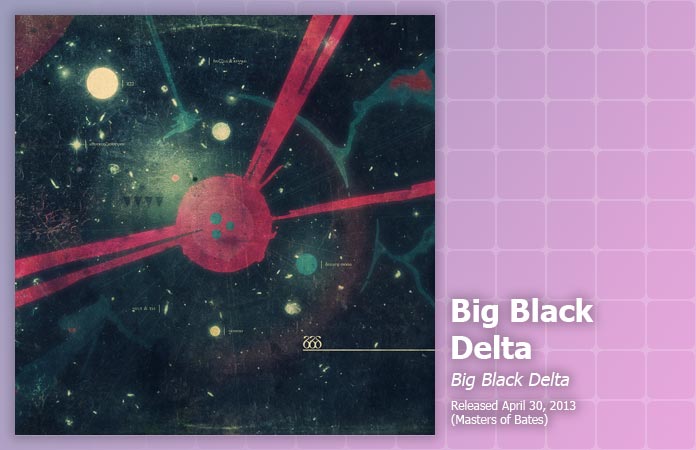
The claim that music with keyboards and synthesizers isn’t “real music” or is just crap has gone on long past its sell-by date. It was tired in the ’80s; now it’s just embarrassing. If music makes you feel something on a gut level—or hell, if it just makes you want to hit the dance floor—then who cares if it’s got synths, keyboards, or a didgeridoo?
The anti-keyboard bridge would probably break out the torches and pitchforks for Big Black Delta. Jonathan Bates has taken Phil Spector’s Wall of Sound to its most synthesized, processed extreme. It’s not just that Big Black Delta’s music features a preponderance of electronic sounds, it’s that the sounds include mountains, oceans, and skies.
Comments Off on Music Review: Big Black Delta, Big Black Delta
Music Review: Meat Puppets, Rat Farm
Published on April 29th, 2013 in: Current Faves, Music, Music Reviews, Reviews |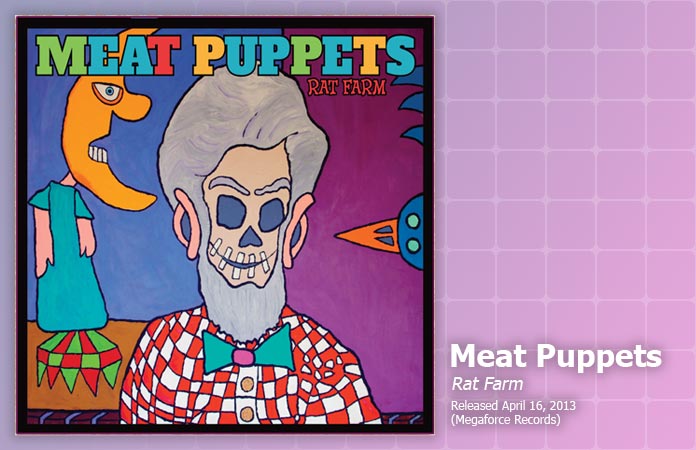
The Meat Puppets are not only icons of the alternative/punk/underground music scenes; they are like fine wines: The band and their music just keep getting better with age. The latest from the Kirkwood Brothers, Rat Farm, is perhaps their finest, the band’s most playful and diverse offering since releasing Up On The Sun in 1985.
Music Review: The Armoury Show, Waiting For The Floods (Reissue)
Published on April 29th, 2013 in: Current Faves, Music, Music Reviews, Retrovirus |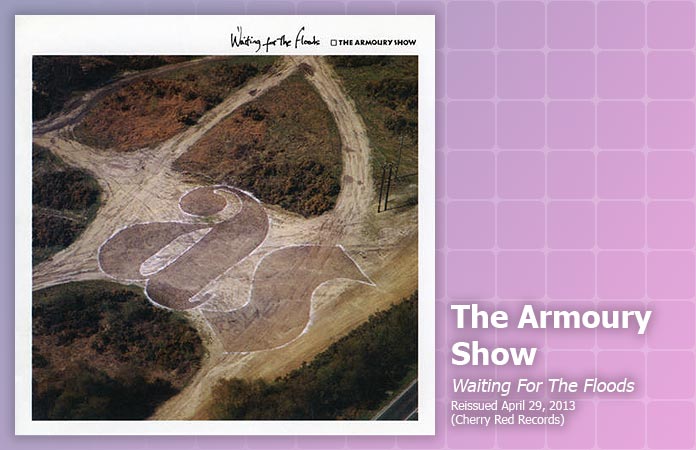
In 1985, The Armoury Show took Britain by storm, billed as the first punk supergroup. By 1987, they had fallen off the radar completely, leaving only one album behind. Cherry Red’s reissue of that album, Waiting For The Floods, is a beautiful shiny thing, a welcome rediscovery of a band that faded out far too quickly.
Consisting of former members of Magazine, The Skids, and Siouxsie & the Banshees (John McGeoch!), The Armoury Show served up gorgeously slick cathedral Goth with strangely danceable grooves. Theirs was not music for the stand and shuffle crowd. You could dress up in your funereal best and still sway your anthemic hips, maybe even crack a smile.
Blu-Ray Review: Life Of Pi
Published on April 24th, 2013 in: Blu-Ray, Books, Current Faves, DVD/Blu-Ray Reviews, Movie Reviews, Movies, Reviews |
TM and © 2011 Twentieth Century Fox Film Corporation. All rights reserved. Not for sale or duplication.
Those who read Yann Martel’s Life of Pi towards the beginning of the last decade probably wondered how such a fantastic tale could ever be filmed. There were also those who, upon hearing that Ang Lee was tackling a film version of Life of Pi, felt elated and relieved that someone with such talent and commitment to a story was the one chosen.
Comments Off on Blu-Ray Review: Life Of Pi
Music Review: The Chapin Sisters, A Date With The Everly Brothers
Published on April 23rd, 2013 in: Current Faves, Feminism, Music, Music Reviews, New Music Tuesday, Reviews |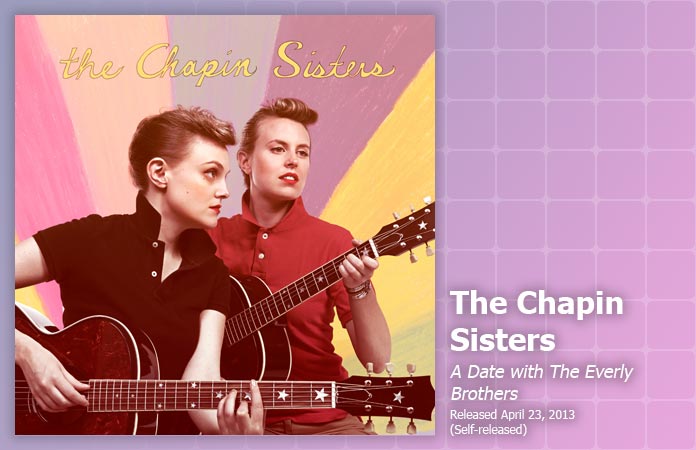
Like The Everly Brothers, The Chapin Sisters come from a musical family. Their father is Grammy-award-winning musician Tom Chapin; their uncle was folk singer and humanitarian Harry Chapin. This pedigree shows in their most recent release, A Date With The Everly Brothers, an album of 14 cover songs by the beloved duo.
A Date With The Everly Brothers focuses on the songs released by the siblings between 1957 and 1961, the most commercially successful period in their career. About half of the songs are Everly originals; most of the rest are Felice and Boudleaux Bryant compositions from the brothers’ tenure on Cadence Records in the late ’50s.
Comments Off on Music Review: The Chapin Sisters, A Date With The Everly Brothers
Music Review: Luke Winslow-King, The Coming Tide
Published on April 23rd, 2013 in: Current Faves, Music, Music Reviews, New Music Tuesday, Reviews |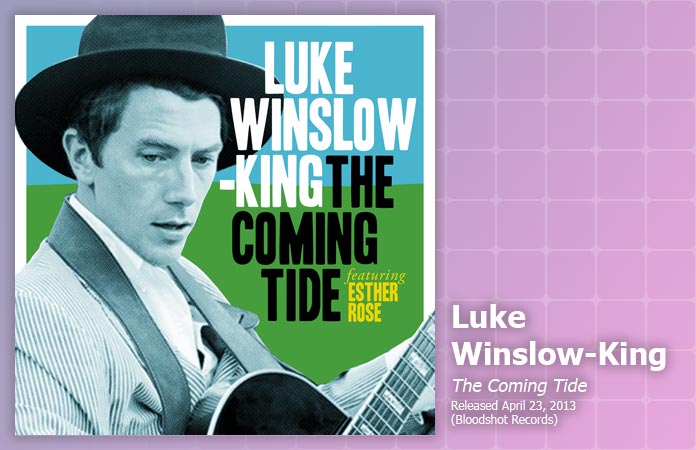
I once saw Luke Winslow-King perform a miracle. He was opening for Jack White, which is, of course, miraculous in and of itself, and Jack White’s audience was less than receptive to this man in a seersucker suit with a guitar, a woman playing a washboard, and a fellow with a standup bass. The most amazing thing was watching the audience’s attitude change. By the third song in his set, Luke Winslow-King had made fans. His performance was engaging, wickedly tuneful, and pretty much brilliant. The interplay between him and washboard player/backup singer Esther Rose was charming. By the time his set was over, the merch table was flooded with people buying his CD.
Comments Off on Music Review: Luke Winslow-King, The Coming Tide
Music Review: IO Echo, Ministry Of Love
Published on April 18th, 2013 in: Current Faves, Feminism, Music, Music Reviews, Reviews |
There are albums so good, the task of describing them seems overwhelming. Yet the glorious challenge of explaining why the songs are amazing can be a real honor, especially if even one person reads my paltry words, buys the album, and is thus transported.
So it is with Ministry of Love, the debut album from the duo of Ioanna Gika and Leopold Ross, who form IO Echo. They marry the proto-goth of early Cure and Siouxsie with the lushness of Cocteau Twins and School of Seven Bells in songs informed by the subtle yet strong undercurrents of Asian sonics. Despite what my descriptions might imply, Ministry of Love isn’t bleak. The euphoric pop of songs like the title track and “Ecstasy Ghost” ensure that the album never feels morose, although it skirts the edges of unsettling.
Music Review: Lynsey de Paul, Sugar And Beyond/Into My Music Anthologies
Published on April 10th, 2013 in: Current Faves, Feminism, Music, Music Reviews, Retrovirus, Reviews |By Hanna
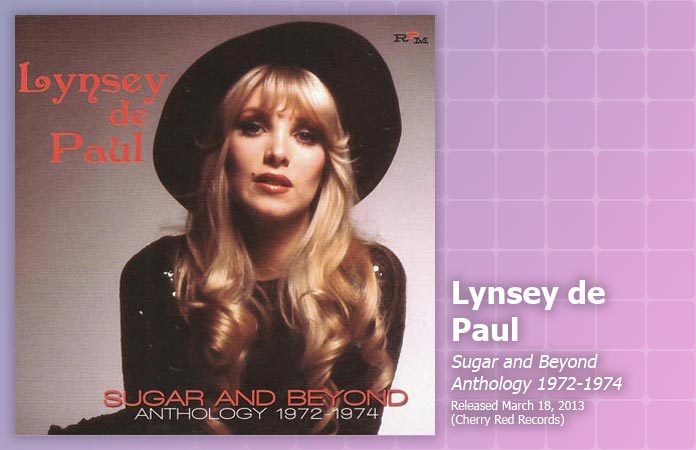
The entire ‘70s catalogue of pioneering female singer/songwriter Lynsey de Paul has finally been collected in two new anthologies: Sugar and Beyond 1972 – 1974 and Into My Music 1975 – 1979. Using exclusive material and information from Lynsey de Paul herself, this is a unique collection, signifying a new chance to discover her work and to grant it the recognition it deserves.
Westeros in West Midtown: Game Of Thrones: The Exhibition
Published on April 3rd, 2013 in: Current Faves, Museum Exhibitions, TV |By Maureen
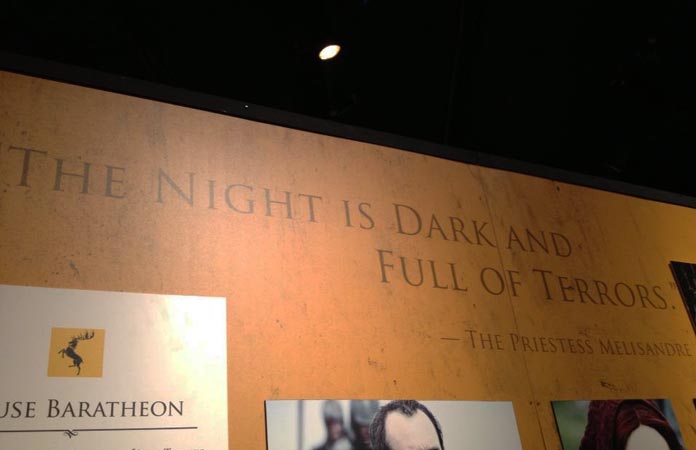
I knew that I would have to wait in line for Game Of Thrones: The Exhibition. It came to New York City for only five days amidst a five-city world tour to promote the show before season three’s premiere. I knew it would be crowded, and I knew it would probably end up taking a whole day to look at half an hour’s worth of an exhibit. I was right about all of these things.
What I didn’t anticipate, however, was how worth it that would all be. I got there about 1:45 p.m. on Friday, and was let into the exhibit at about 4:45 p.m. During the wait, staff members of the exhibit walked up and down the line shouting out trivia questions, and my boyfriend won a pen light by answering “what song is used to convey the message ‘don’t mess with the Lannisters’?” Mostly, though, we were just reading/playing games on various devices.
Comments Off on Westeros in West Midtown: Game Of Thrones: The Exhibition
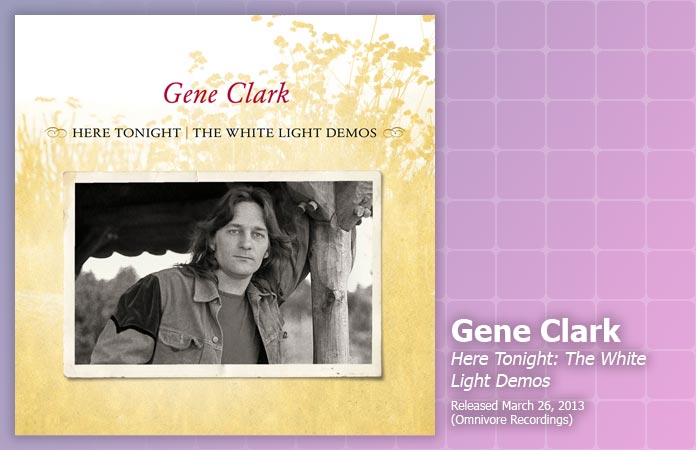
Music Review: Gene Clark, Here Tonight: The White Light Demos
Published on April 2nd, 2013 in: Current Faves, Music, Music Reviews, New Music Tuesday, Retrovirus, Reviews |By Cait Brennan
The experience of being alive is joyous and unbearable. This crude matter we’re made of fights us every step of the way, but something deeper, something more, some beauty and energy blasting through from a source we can’t know animates us, fills us, drives us onward, and the friction, the vibration of energy that moves us, is what we call music. Where does it go, do you suppose, when we’re gone? Nobody knows, but you’ve gotta hope that when the radio breaks, still the signal shines on.
If rock and roll means anything worth caring about, it’s the need to express something real and beautiful and transcendent from the human soul. But that need can lead to soul-destroying results. There’s a fake thing called fame today, but it’s nothing like the sun that blistered down on the rock and roll bands of the 1960s. Know-nothing hambones like Mike Love get out in front and let their egos feast on the callow roar and toxic adulation of the crowd while sucking the lifeblood out of the delicate creative genius that brought them to the party, like a fat tick on a sick dog. The songwriter gets in the way? Kick ’em out of the band and keep the carnival on the road. Don’t mess with the formula, right?
Which brings us to the Byrds’ creative genius, Gene Clark. A down-to-earth, folk-influenced kid from the Midwest, he co-founded the band, and (excepting a few covers written by some stray named Robert Zimmerman) was the songwriting powerhouse behind the Byrds’ golden age. Just a few of the highlights he wrote or co-wrote: “I’ll Feel A Whole Lot Better,” “She Don’t Care About Time,” “I’m Feelin’ Higher,” “If You’re Gone,” “Here Without You,” “The World Turns All Around Her,” “Set You Free This Time,” oh, and a little number called “Eight Miles High.”