Music Review: Johnny Marr, The Messenger
Published on April 2nd, 2013 in: Music, Music Reviews, New Music Tuesday, Reviews |By Cait Brennan
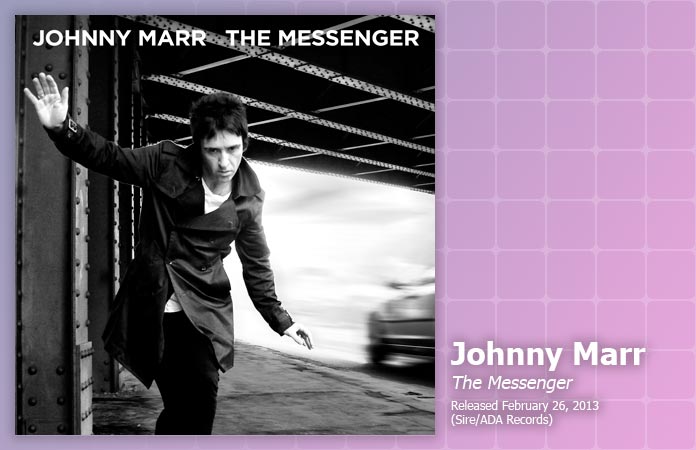
“Hear me, the wonder of it,” Johnny Marr sings on “The Right Thing Right,” the opening track of his new solo album The Messenger. Marr essentially invented ’80s Britpop with The Smiths, a band whose hallmarks featured Marr’s blazing melodic runs and (oh god let’s just get it over with) jangling guitars, serving as the perfect counterpoint to those literate, mannered, melancholic lyrics from an obscure vocalist whose name time has sadly forgotten.
In the intervening years, as The Smiths’ influence has grown to legend, countless guitarists have reproduced that iconic sound with near-religious devotion. Everybody, it seems, but Marr himself, who often seemingly took pains to play like somebody, anybody other than that guy on The Smiths records. While Morrissey rose to new heights as a writ-large, Nicholas Ray CinemaScope version of himself, Marr left it all behind, blazing an exhaustive, exhausting trail through new sounds and new identities that would wear out Richard Kimble.
Comments Off on Music Review: Johnny Marr, The Messenger
Music Review: Gene Clark, Here Tonight: The White Light Demos
Published on April 2nd, 2013 in: Current Faves, Music, Music Reviews, New Music Tuesday, Retrovirus, Reviews |By Cait Brennan
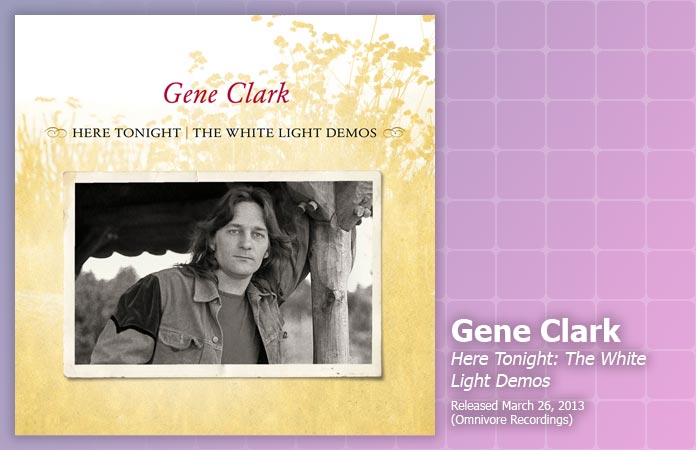
The experience of being alive is joyous and unbearable. This crude matter we’re made of fights us every step of the way, but something deeper, something more, some beauty and energy blasting through from a source we can’t know animates us, fills us, drives us onward, and the friction, the vibration of energy that moves us, is what we call music. Where does it go, do you suppose, when we’re gone? Nobody knows, but you’ve gotta hope that when the radio breaks, still the signal shines on.
If rock and roll means anything worth caring about, it’s the need to express something real and beautiful and transcendent from the human soul. But that need can lead to soul-destroying results. There’s a fake thing called fame today, but it’s nothing like the sun that blistered down on the rock and roll bands of the 1960s. Know-nothing hambones like Mike Love get out in front and let their egos feast on the callow roar and toxic adulation of the crowd while sucking the lifeblood out of the delicate creative genius that brought them to the party, like a fat tick on a sick dog. The songwriter gets in the way? Kick ’em out of the band and keep the carnival on the road. Don’t mess with the formula, right?
Which brings us to the Byrds’ creative genius, Gene Clark. A down-to-earth, folk-influenced kid from the Midwest, he co-founded the band, and (excepting a few covers written by some stray named Robert Zimmerman) was the songwriting powerhouse behind the Byrds’ golden age. Just a few of the highlights he wrote or co-wrote: “I’ll Feel A Whole Lot Better,” “She Don’t Care About Time,” “I’m Feelin’ Higher,” “If You’re Gone,” “Here Without You,” “The World Turns All Around Her,” “Set You Free This Time,” oh, and a little number called “Eight Miles High.”
Movie Review: G.I. Joe: Retaliation
Published on April 1st, 2013 in: Comics, Movie Reviews, Movies, Reviews |By LabSplice
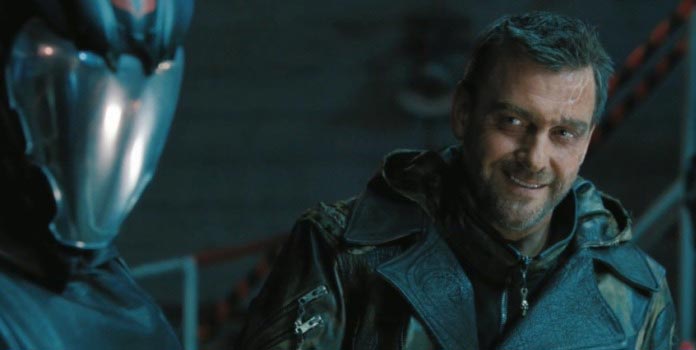
In G.I. Joe: Retaliation, the Joes are no more. The entire squad and their leader were wiped out in a double-cross by Zartan, the Cobra lieutenant who has impersonated the president of the United States and is working from within the government to free Cobra Commander. The remaining Joes, led by Roadblock (Dwayne Johnson), are forced to take on a government that no longer trusts them and rescue the entire world from the brink of nuclear war.
You almost have to feel sorry for way the cards were stacked against G.I. Joe: Retaliation. The first film in the series, G.I. Joe: The Rise of Cobra, limped out of theaters as a critical failure, and many fans would have preferred to see the franchise die an ignominious death without any additional entries. Furthermore, Retaliation suffered from several delays in its production schedule, delays that allegedly arose regarding complications in the use of Channing Tatum’s character, Duke. This meant that the only actors who would reprise their roles in the second film would be Jonathan Pryce as the president of the United States, Byung-hun Lee as Storm Shadow, and the silent and faceless presence of Ray Park as Snake Eyes. Throw in a few quick scenes with Arnold Vosloo as Zartan and you had perhaps the most underwhelming core of franchise talent in summer blockbuster history.
Game Review: Bioshock Infinite
Published on April 1st, 2013 in: Current Faves, Game Reviews, Gaming, Reviews, Science Fiction |By Paul Casey
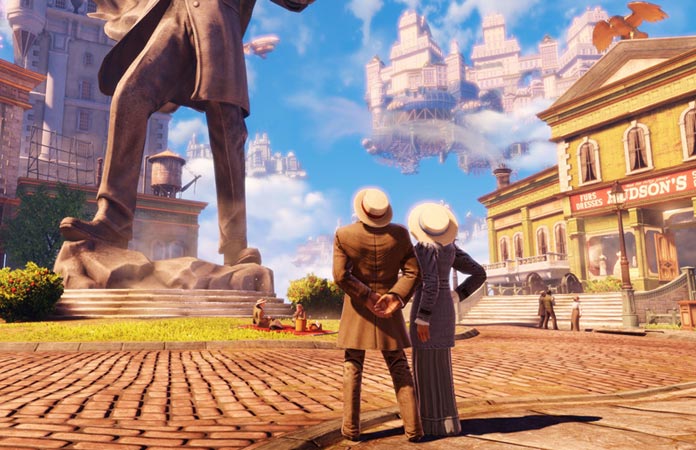
When Science Fiction reaches a large, mainstream audience it frequently stumbles. There are those out there, we are reminded until we expel body liquid, who are not particularly enamored with the idea of bizarre imaginings or Dystopian re-purposing of real events. These unreal things must be shrouded or hidden or compromised to meet the exacting standards of a public that drives Michael Bay pictures to earn hundreds of millions of dollars. They simply will not accept things that cannot happen, unless they get something tangible in return. “Gimme that walking arse shot or allusions to ear-fucking Megan Fox, whatever; just make sure that those grinning mugs don’t get their sense of reality altered! We’re running a business here. Don’t go abstract. Don’t make bold statements.”
When Irrational Games did Bioshock, it seemed to me, and some other folks, that here was a legitimate, big-budget step towards a new philosophy in video games. One that did not insist that the bare mechanics were the only thing worth evaluating. It made a powerful argument for world building, art direction, and quality writing and acting being able to do more than give finely tuned aiming and shooting a pretty wrapping. In Bioshock these things impacted the player’s experience to such a degree that evaluating one without the other seems foolish. That game had its issues, but its issues were a result of its ambition.
Bioshock Infinite is what happens when that ambition finds larger public, creative, and financial support. There is a storytelling depth here that very few games have approached. More importantly, it is a braver and more challenging piece of work than any of the other narrative successes in recent years. Its politics are not easily identifiable—though I am sure there are some lining up to suggest it fails because it contradicts some ideology or other—and its examination of human flaws leads the player to bad, honest places. If there is any clear message to be taken, it is probably that people who seek power are invariably the people who should not possess it, regardless of how righteous they appear.
Comments Off on Game Review: Bioshock Infinite
Music Review: Atoms For Peace, Amok
Published on March 28th, 2013 in: Current Faves, Music, Music Reviews, Reviews |By J Howell
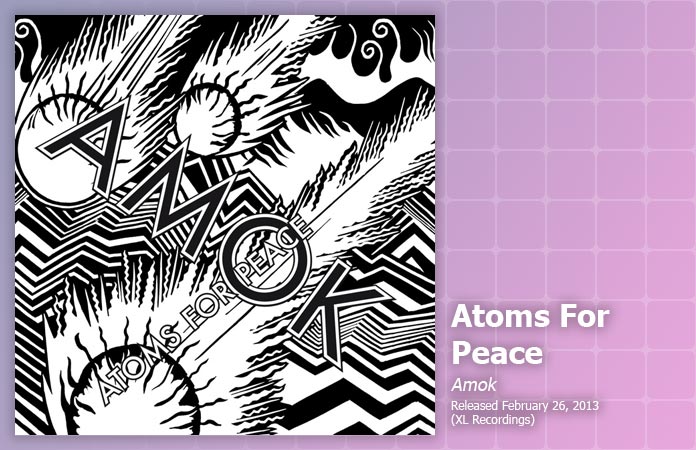
One of the most difficult considerations in music criticism lies in following an artist’s career for the long haul and remaining objective enough about said artist’s work to give it a fair shake. This notion really hit home for me in a major way recently while listening to and thinking about the most recent Nick Cave and The Bad Seeds record. Push The Sky Away is a record I came to fully appreciate only after at least a dozen spins—long enough to finally let go of some of my expectations from Cave and the Seeds and just listen (review).
That’s kind of the bitch of following a body of work enthusiastically over years (or decades). Avoiding becoming jaded is a subject far beyond the scope of this review, but even if it seems obvious, it’s worth noting that after a certain point, it’s hard to get the same life-altering feeling you got when you heard “Tupelo” or “Taut” or Bone Machine or Doolittle (wait—scratch that, I still get that teenage feeling listening to Doolittle) or “Paranoid Android” for the first time.
What we get in return for following where people like Cave or Polly Harvey or Thom Yorke—with Atoms For Peace’s Amok—lead may not always be that immediate, profound experience of hearing something important for the first time. When you’re lucky, though, the sense of growing and changing, maybe even maturing (it’s okay to wince; I did typing) alongside such artists, finding their work still (and sometimes strangely) relevant to where you find yourself right now, can be just as rewarding.
Comments Off on Music Review: Atoms For Peace, Amok
Canadian Music Week Film Fest Movie Review: Big Star: Nothing Can Hurt Me
Published on March 26th, 2013 in: Current Faves, Documentaries, Film Festivals, Movie Reviews, Movies, Music, Reviews |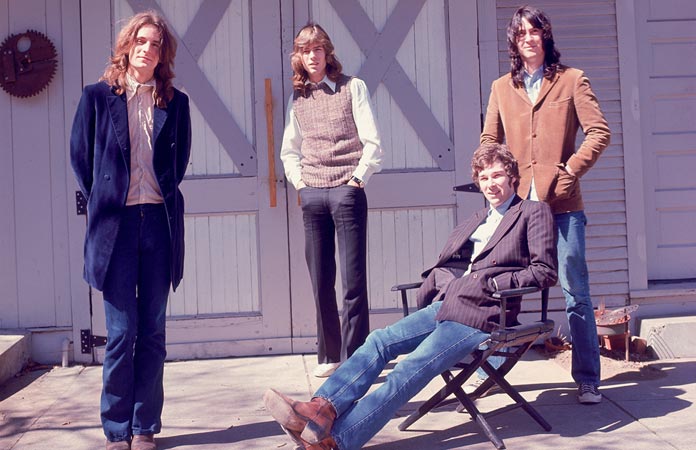
When I first heard Big Star, I wondered “Why weren’t these guys huge?” like all their other fans have been wondering for the last 40-plus years. Big Star: Nothing Can Hurt Me answers the why, but their lack of mainstream success still boggles the mind. When Brian Wilson sang “I Just Wasn’t Made For These Times,” he could have easily been singing about Big Star.
The story of Big Star is full of both good things—talent, camaraderie, ambition—and terrible ones—bad luck, personal demons, and death. This mixture of the bitter and the sweet is a good metaphor for Big Star’s music, which fuses the two in an unforgettable aural and emotional experience. This is what drew fans and critics to the band and what continues to characterize their legacy.
Music Review: Wendy & Lisa, Wendy and Lisa
Published on March 25th, 2013 in: Feminism, LGBTQ, Music, Music Reviews, Reviews |By Paul Casey
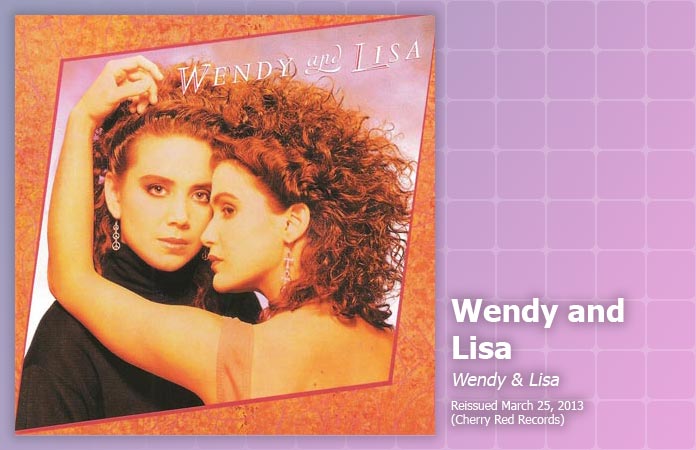
Wendy & Lisa have put out five albums and one EP of original material during the years they have worked as a duo. For such a talented pair this does not seem like nearly enough. The benefit of having so few albums is, however, there is no off period. Their debut, Wendy and Lisa, came out in 1987 and started a (short) string of great albums. It is a classic of the 1980s, and unavoidably a document of what Prince lost when he fired Wendy, Lisa, and Bobby Z. (who co-produces the album).
Comments Off on Music Review: Wendy & Lisa, Wendy and Lisa
Movie Review: Olympus Has Fallen
Published on March 25th, 2013 in: Action Movies, Movie Reviews, Movies, Reviews |By LabSplice
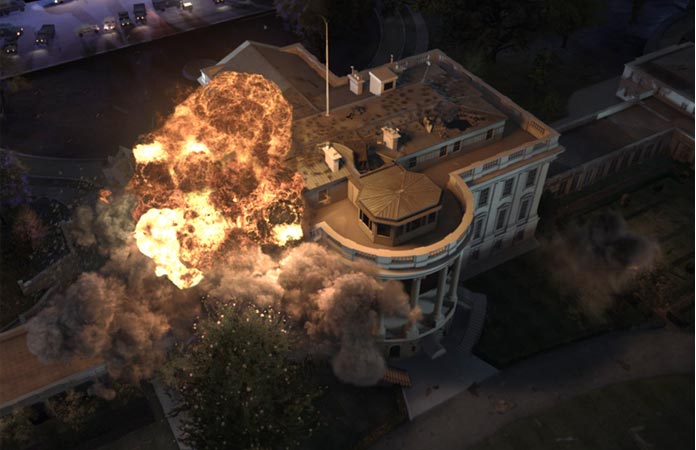
In Olympus Has Fallen, Gerard Butler plays Mike Banning, a former secret service agent who has been reassigned to a desk job after the accidental death of the First Lady. It has not been an easy transition; Banning feels the loss of his extended first family and drifts through his life disconnected from those around them. However, his shot at redemption comes when a small band of terrorists take over the White House under the guise of a peace envoy from South Korea. As the only man left alive, Banner must overcome his past failures to ensure that the leaders of the country are not used as pawns in a nuclear war against the United States.
While Olympus Has Fallen received comparisons to Die Hard even before it was released, the movie is not content to draw on only one inspiration and borrows heavily from across the genre. There is no shortage of ’90s action films that pit a lone agent against a small force of terrorists who have taken over a building or installation. I lovingly refer to these films as Only Hope We’ve Got movies—they often feature a roundtable of government officials who argue over what to do with their inside agent, only to have one character pound a desk and announce that he or she is the Only Hope We’ve Got.
Canadian Music Week Film Fest Review: Bad Brains: A Band In DC
Published on March 23rd, 2013 in: Current Faves, Documentaries, Film Festivals, Movie Reviews, Movies, Music, Reviews |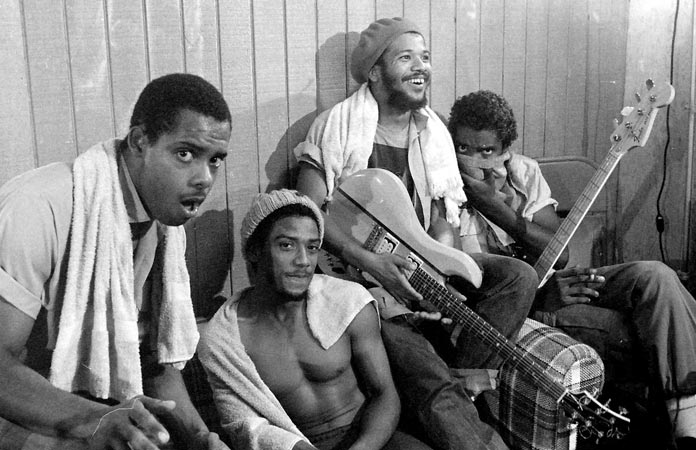
When it comes to bands like Bad Brains, genre becomes meaningless. Influenced by such disparate artists as Chick Corea, The Sex Pistols, The Damned, The Ramones, and Bob Marley, they combined a variety of musical styles into their own unique sound, going on to influence dozens of other musicians (Dave Grohl, The Beastie Boys, Cro-Mags, Red Hot Chili Peppers, to name but a few) in the process.
Bad Brains: A Band in DC, directed by Ben Logan and Mandy Stein, is not an exhaustive account of the history of Bad Brains; that would be impossible, although it would make for an extremely entertaining TV series. When watching the film, you’re not only left with the distinct impression that there are many more stories to be told, but also that you can’t wait to dig into the band’s discography, which includes nine studio albums, a couple dozen singles, a handful of live albums, and appearances on various compilations.
Canadian Music Week Film Fest Review: Apocalypse: A Bill Callahan Tour Film
Published on March 22nd, 2013 in: Film Festivals, Movie Reviews, Movies, Music, Reviews |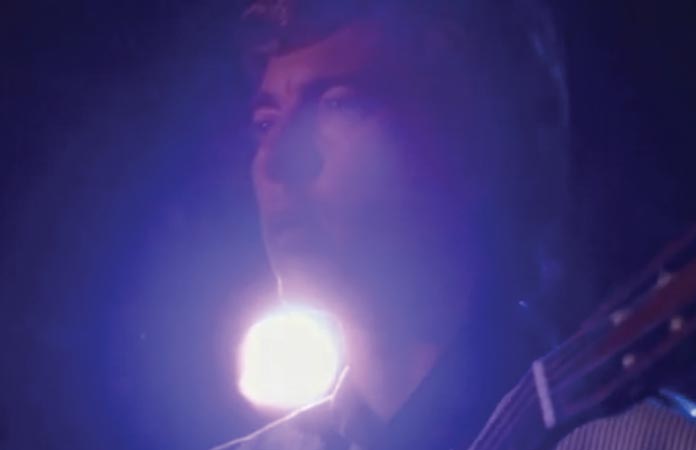
I started watching Apocalypse: A Bill Callahan Tour Film knowing nothing of Bill Callahan. Callahan has been writing, performing, and recording music for almost 25 years, originally under the name Smog, and then with the release of 2007’s Woke on a Whaleheart, under his own name. Apocalypse chronicles Callahan’s US tour in 2011 to support the album of the same name.
Comments Off on Canadian Music Week Film Fest Review: Apocalypse: A Bill Callahan Tour Film