Music Review: Alasdair Roberts & Friends, A Wonder Working Stone
Published on March 12th, 2013 in: Current Faves, Music, Music Reviews, New Music Tuesday, Reviews |By Hanna

A Wonder Working Stone is being hailed as Alasdair Roberts‘s best work so far. Though he can sum it up in one word per song himself, it’s not that easy to capture in a short review. This is partly because it is so varied, and partly because it’s so complex that description becomes difficult.
In a way it’s a definitive album, combining characteristic elements of Alasdair Roberts’s style with new influences, and a cast of highly skilled musicians. There is an atmosphere of creative friendship in the album, especially in the extended sequences of various songs played together.
Comments Off on Music Review: Alasdair Roberts & Friends, A Wonder Working Stone
Music Review: Girls Names, The New Life
Published on March 12th, 2013 in: Current Faves, Music, Music Reviews, New Music Tuesday, Reviews |
I’m running out of ways to describe new bands as deft reinterpreters of the legacy of post-punk music. Belfast’s Girls Names is no exception, but The New Life, their new album, is still exceptionally good.
Those who try to recreate the sound of the late ’70s/early ’80s goldmine of great music often fall victim to throwing in everything that defined the era in an attempt to be as on-the-nose as possible: synths, drum machines, hand claps, samples, gospel choirs, and horn sections. Less is more, and Girls Names know how to do a lot with a little.
Comments Off on Music Review: Girls Names, The New Life
Music Review: David Bowie, The Next Day
Published on March 12th, 2013 in: Current Faves, Music, Music Reviews, New Music Tuesday, Reviews |By Cait Brennan

It takes a giant set of stones to deface, obliterate really, the cover to “Heroes”, the 1977 album that is often regarded as David Bowie’s masterpiece. You wouldn’t do it for a remix record, let alone a new album that heralds your return to music after a decade as far away from the music world as you can get, on this side of the dirt at least. You wouldn’t pay some guy a ton of money to just scratch out the album title and paper over the face with some words on a blank slate.
But then David Bowie has always been that blank slate. The Next Day equals “The Next Thing,” the tantalizing, elusive thing Bowie has restlessly, relentlessly pursued since the day he first imagined his pilfered name in lights. New sounds, new poses, new ideas, borrowed and digested and inhabited and discarded, with the artificial cool and sublimated panic of a man trying desperately to stay one step ahead of the law, sick inside with the feeling that any second, he’ll be exposed as a fraud, a con man, a cut-rate Tabarin in a rented clown suit that’s four days past due and damaged beyond hope of getting back the deposit. We mustn’t ever tell him that it’s all in his head, that he’s real and he’s good and that he’s saved us, the ones that he’s saved.
But now, no new pose, no fashion, no fame, just a blank slate, a screen on which to project your own version of the dream. Is this the end of The Prisoner then, where Bowie rips the monkey mask off the madman he’s chased, only to find his own true face underneath?
Oops, should have said “spoiler alert.”
Music Review: Otis Redding, Lonely & Blue: The Deepest Soul of Otis Redding
Published on March 7th, 2013 in: Current Faves, Music, Music Reviews, Reviews |By Emily Carney
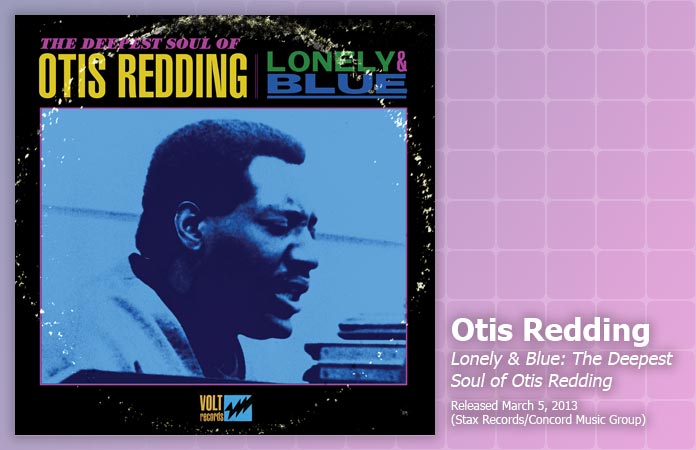
Sadly, Otis Redding‘s music seems to have limped off into the sunset, despite having a posthumous number one hit with “Sitting on the Dock of the Bay” in 1967. Redding’s one hit was relegated to “classic rock” stations and was associated with MOR entertainment; his name was tainted with the voices of countless awful disc jockeys. However, a new disc should change his image: Lonely & Blue: The Deepest Soul of Otis Redding showcases his absolutely heart-wrenching soul songs.
The disc opens with “I Love You More Than Words Can Say,” which should, by rights, be the only love song ever written—it pretty much says it all and Redding’s voice is heartbreaking. It can be argued that great singers are actors; they tend to “act out” the songs they perform. Otis pours his heart out into every note—and no note is performed wrong.
“Gone Again” and the eerie “I’ve Got Dreams to Remember”—which references an airplane flying across the sky, his particular manner of death—are highlights of this disc, although each cut is an emotional tour de force. This is not easy listening if you’re feeling sad, beaten-down, and lonely, hence the name of Lonely & Blue. One becomes sad recalling that soon, Redding wouldn’t have dreams to remember.
“. . . You are the one that loved me,” Redding sings in another choice tune, “Everybody Makes a Mistake.” Redding deserves to have his due, even at the late date of 2013; he deserves to be loved. His pleading, emotional voice almost echoes a more contemporary star of R&B, the equally doomed Amy Winehouse. This is essential listening for those obsessed with soul, R&B, and music in general.
Lonely & Blue: The Deepest Soul of Otis Redding was released March 5 on Stax Records through Concord Music Group. It is available to order from the Concord Music website.
Comments Off on Music Review: Otis Redding, Lonely & Blue: The Deepest Soul of Otis Redding
Music Review: Nick Cave & the Bad Seeds, Push The Sky Away
Published on March 6th, 2013 in: Current Faves, Music, Music Reviews, Reviews |By J Howell
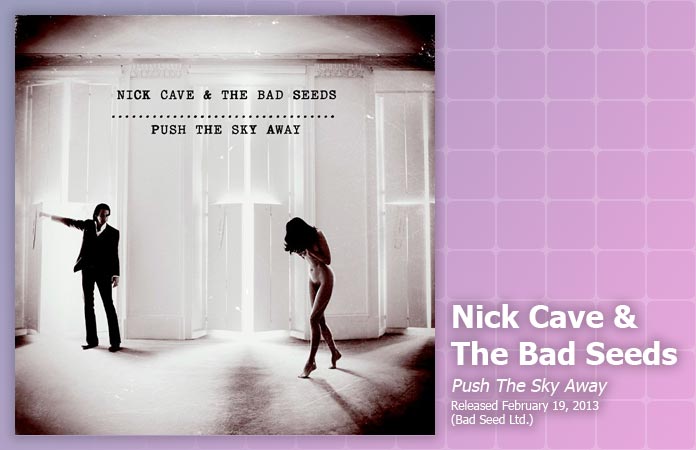
Speaking about Push The Sky Away out of the context of Nick Cave‘s impressive and prolific body of work thus far is a bit difficult, but the Bad Seeds’ 15th album deserves to be taken on its own terms.
When a longtime friend posted a Cave-related link on Facebook, I mentioned that I’d received a review copy and was listening to it just then. This started (another) discussion about vintage versus newer Bad Seeds albums, a not-infrequent topic of conversation between myself and said friend, who holds Henry’s Dream-era Cave as the Seeds at the height of their powers.
A couple of songs in, I commented that, while the record was pleasant so far, it felt subdued—my exact words at the time were, “It’s good, but it’s like Abbatoir Blues took its antidepressants, which were just enough to make it not angry.” Especially coming off the heels of Cave’s recent, ferocious Grinderman records, Push The Sky Away, at least initially, comes across as perhaps just a bit soft. Which is, as it turns out, ultimately complete bullshit.
Or not, depending on one’s perspective and expectations. I’m of the mind that, while it takes a few listens for its full impact to be felt, Push The Sky Away is a beautiful record that holds up against any of Cave and the Bad Seeds’ other work, or anyone else’s.
Comments Off on Music Review: Nick Cave & the Bad Seeds, Push The Sky Away
Music Review: Bajofondo, Presente
Published on March 5th, 2013 in: Culture Shock, Current Faves, Music, Music Reviews, New Music Tuesday, Reviews |
A few weeks ago, Bajofondo released their latest single, “Pide Piso,” on iTunes with little fanfare. As an admirer of musical polymath and Bajofondo member Juan Campodonico, I picked it up with little hesitation. Campo’s self-titled 2012 album caught my attention when it was nominated for the best Latin Alternative Grammy, and its ethereal songs and playful aesthetic made it a worthy competitor in that category.
Though Bajofondo takes a more restless approach to their chosen genre and musical tradition than did Campodonico’s solo project, his approach to music made me curious about how he’d work in a more collaborative setting. The 99-cent risk paid off, and the cascading melodies, shuffling electronic percussion, widescreen string section, and deft use of samples frequently made it into daily play.
Music Review: Helado Negro, Invisible Life
Published on March 5th, 2013 in: Current Faves, Music, Music Reviews, New Music Tuesday, Reviews |
The phrase “Helado Negro” translates into English as “black ice cream,” a seeming non sequitur that makes sense, in a strange way, for this studio project. Invisible Life features songs that carry a hint of comfort and refreshment, the way that sweet frozen treats do. However, the use of unexpected sonic textures brings with it an unexpected tang—like licorice ice cream—and the lush melodies and arrangements have an intoxicating aftertaste, like a scoop of vanilla in a pint of stout.
On his second LP, Invisible Life, Roberto Carlos Lange—the man behind Helado Negro—has written a series of lush melodies, which he stretches languorously over slow tempos and unusual time signatures. This makes his work sound as though it could form the soundtrack to a color-saturated character study inspired by the French New Wave or Wong Kar-Wai. He sings in a scratchy-sounding chest voice, sometimes allowing himself to lapse into a reedy, vulnerable falsetto. The conversational rhythms of his singing suggest Let’s Dance-era David Bowie, a comparison extended by Lange’s embrace and non-ironic use of obsolete musical technologies.
Comments Off on Music Review: Helado Negro, Invisible Life
Music Review: Las Acevedo, Homemade Cookies EP
Published on February 27th, 2013 in: Culture Shock, Current Faves, Feminism, Music, Music Reviews, Reviews |
Sometimes judging a record by its sleeve yields unexpected rewards. While reading the blog Puerto Rico Indie in search of news about a rumored upcoming release by Rita Indiana, I came across a free compilation put together by the up-and-coming band Las Acevedo. The hand-drawn and collaged sleeve art, with its depiction of a purple-haired, antlered girl snuggling a guitar, drew me in, and within a matter of seconds I found myself purchasing their EP Homemade Cookies from their Bandcamp site.
Comments Off on Music Review: Las Acevedo, Homemade Cookies EP
Music Review: Emily Bindiger, EMiLY
Published on February 25th, 2013 in: Current Faves, Feminism, Music, Music Reviews, Retrovirus, Reviews |
Before Kate Bush or Fiona Apple, there was Emily Bindiger. While on summer leave from the High School of the Performing Arts in New York, Bindiger was cast in the legendary, star-making French revue Double V. She dropped out of school and traveled to Paris alone to appear in the show. Through Double V, Bindiger met Michel Polnareff, who introduced her to the members of the psychedelic pop band Dynastie Crisis. Bindiger’s lone solo album, EMiLY, was released through Pathe in 1972. In honor of the album’s fortieth anniversary, British label Cherry Red has given EMiLY its MP3 debut.
Comments Off on Music Review: Emily Bindiger, EMiLY
Music Review: Matmos, The Marriage of True Minds
Published on February 21st, 2013 in: Current Faves, Music, Music Reviews, Reviews |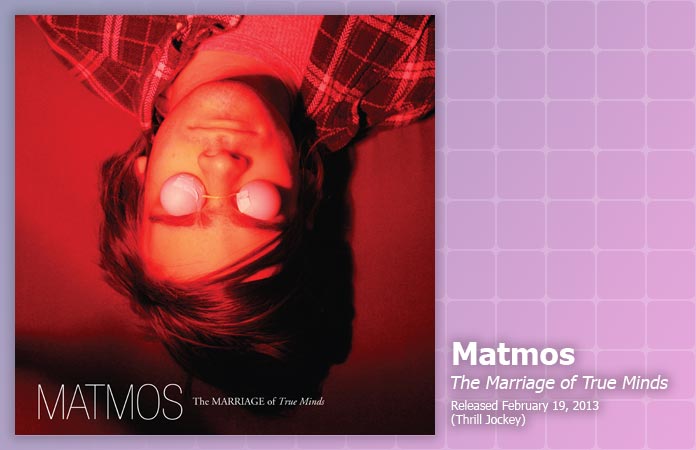
One of the best things about Matmos is their enduring sense of the wacky. It’s rare to find truly challenging and avant garde music, but rarer still to find some with a sense of humor. One of the ways that expresses itself is in their penchant for bizarre—almost gimmicky—methods of making music and collecting sounds.
This time this is focused less on the use of weird noises, but on the entire way of making the album. The buzzword for The Marriage of True Minds is telepathy, continuing from The Ganzfeld EP from last year (review). Both works were made using ganzfeld experiments; a pseudoscientific method of tapping into the psychic senses by limiting regular sensory perception and creating a ganzfeld effect; an effect similar to sensory deprivation. It’s characterized by the halved ping pong balls placed over the eyes, like the beginnings of a Crow from MST3K cosplay. By carrying out ganzfeld experiments on their friends over the years and recording the results, the basic structure of this album was formed.
Comments Off on Music Review: Matmos, The Marriage of True Minds