Music Review: Luke Winslow-King, The Coming Tide
Published on April 23rd, 2013 in: Current Faves, Music, Music Reviews, New Music Tuesday, Reviews |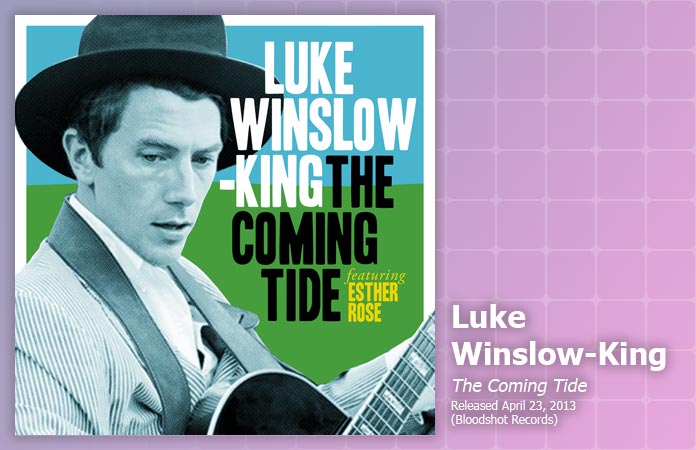
I once saw Luke Winslow-King perform a miracle. He was opening for Jack White, which is, of course, miraculous in and of itself, and Jack White’s audience was less than receptive to this man in a seersucker suit with a guitar, a woman playing a washboard, and a fellow with a standup bass. The most amazing thing was watching the audience’s attitude change. By the third song in his set, Luke Winslow-King had made fans. His performance was engaging, wickedly tuneful, and pretty much brilliant. The interplay between him and washboard player/backup singer Esther Rose was charming. By the time his set was over, the merch table was flooded with people buying his CD.
Comments Off on Music Review: Luke Winslow-King, The Coming Tide
Mourning The Loss Of Scott Miller, 1960 – 2013
Published on April 19th, 2013 in: Music, Obituary |
Here are four words I hoped I’d be writing in 20 years or so: Scott Miller has died. The front man for seminal, underrated bands Game Theory and the Loud Family died suddenly on April 15, 2013, in San Mateo, California.
Music Review: IO Echo, Ministry Of Love
Published on April 18th, 2013 in: Current Faves, Feminism, Music, Music Reviews, Reviews |
There are albums so good, the task of describing them seems overwhelming. Yet the glorious challenge of explaining why the songs are amazing can be a real honor, especially if even one person reads my paltry words, buys the album, and is thus transported.
So it is with Ministry of Love, the debut album from the duo of Ioanna Gika and Leopold Ross, who form IO Echo. They marry the proto-goth of early Cure and Siouxsie with the lushness of Cocteau Twins and School of Seven Bells in songs informed by the subtle yet strong undercurrents of Asian sonics. Despite what my descriptions might imply, Ministry of Love isn’t bleak. The euphoric pop of songs like the title track and “Ecstasy Ghost” ensure that the album never feels morose, although it skirts the edges of unsettling.
Waxing Nostalgic: Roger Waters, “5:01 AM (The Pros and Cons of Hitch Hiking, Part 10)”
Published on April 17th, 2013 in: Music, Waxing Nostalgic |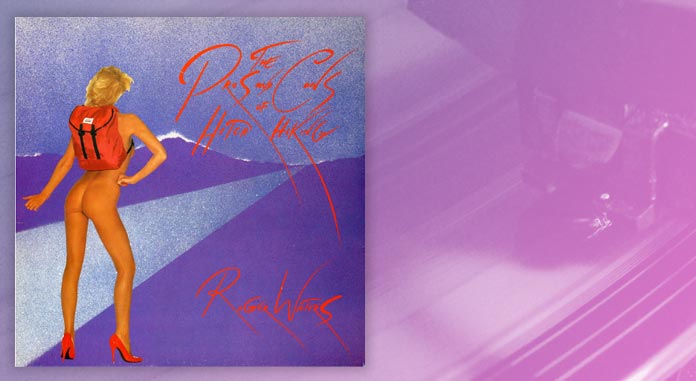
Here’s a bit of rock and roll heresy for you on this fine day. I don’t care a whit for Pink Floyd. I believe them to be overexposed, overplayed, and overrated. Their music is the background of every “classic rock” radio station, mostly because of people whose parents were fans, folks who still think it is astonishingly weird and semi-artsy to hear machinery noises and people speaking backwards on a musical record. I don’t think smoking pot has anything to do with it and you don’t need hallucinogens to be bored by Pink Floyd. We have been told for decades that the Floyd is an amazing band, one to be treasured, and we believed it. There must be something in our brains, some incredible desire to hear an open D note, staccato plucked, over and over and over again.
To hell with The Wall, to hell with Dark Side of the Moon, and to double hell with The Final Cut. I am reasonably sure I am not alone in this opinion. I’m also sure the comments section will let me know if I’m wrong.
Here comes the big “but.”
Comments Off on Waxing Nostalgic: Roger Waters, “5:01 AM (The Pros and Cons of Hitch Hiking, Part 10)”
Concert Review: The Hives At House of Blues
Published on April 16th, 2013 in: Concert Reviews, Music, Reviews |Text and photos by Julie Finley
Cleveland, OH
March 10, 2013

The Hives recently tore through Cleveland and not a moment too soon, since there hasn’t been ANYTHING worth seeing live since . . . well . . . Firewater from last year. Otherwise, Cleveland is as bereft of culture and entertainment as ever (despite what various lame bloggers write about after visiting their loser friend that happens to live here over a weekend, that same loser friend that pretends like they live in a hip and up and coming place. No, it’s down and swirling!).
Comments Off on Concert Review: The Hives At House of Blues
Waxing Nostalgic: Cliff Richard, “Wired for Sound”
Published on April 15th, 2013 in: Music, Waxing Nostalgic |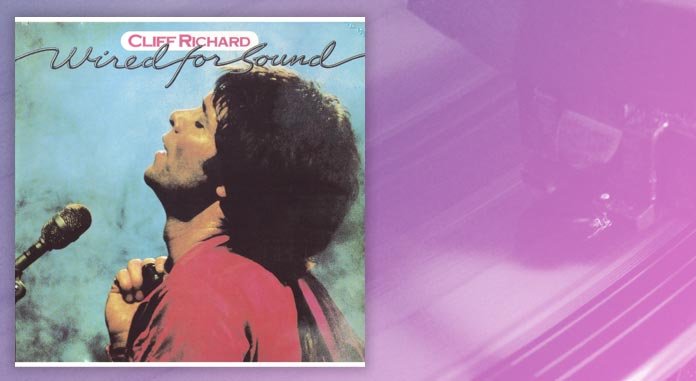
I posed a simple question on Twitter to my British friends. “Friends,” I asked, “what is a Cliff Richard?” My friend Sam, who runs a film blog in the UK, answered, “(noun) A type of person, not from The North.” I feel this answer is much funnier if you’re British, which I am not, but Sam’s a good man who has made me laugh before. I’m sure this response is hilarious.
It’s vague, though, and I get the impression the Britons are afraid to speak of him aloud, like he’s some kind of demon. What happens if you say Cliff Richard’s name five times while staring into a mirror? None have lived to tell.
Comments Off on Waxing Nostalgic: Cliff Richard, “Wired for Sound”
Waxing Nostalgic: Devo, “Beautiful World”
Published on April 11th, 2013 in: Music, Waxing Nostalgic |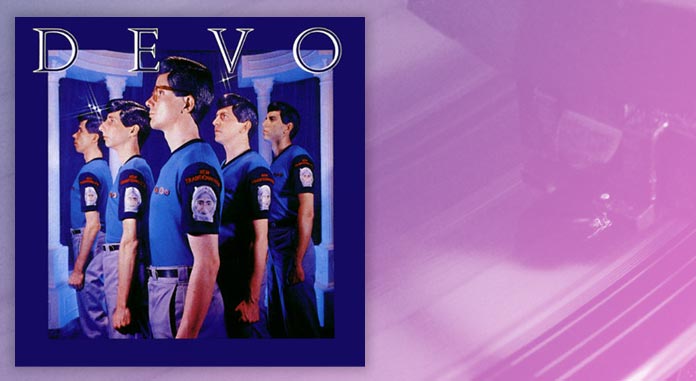
Americans were all primed for the Eighties. It was a decade where something was supposed to happen. Perhaps we all had a touch of Orwellian paranoia, a sense of not knowing which way to lean or who to trust. It was like a great atmospheric pressure swell that needed to break, dark heavy clouds heralding the coming shitstorm. We lived under the constant threat of nuclear war, fearing the goose-step marching of fascists and neo-Nazis down our tree-lined suburban streets. We also went to see The Cannonball Run enough times to make it the sixth highest grossing film of 1981. What were we thinking? Even now, it is hard to believe that anyone needed escapism that badly.
I realize that, if you weren’t there, the Eighties seem shiny and gleeful, like a candy cane on a Ferris wheel. That’s bullshit. Doom and gloom surrounded us and we continued to distract ourselves from it all with whatever we could find. We had to. Nobody wants to wake up every single fucking morning, facing their own mortality! Hell yes, I’ll take that Rubik’s Cube. I’ll play with the colors and make weird geometric designs, whatever, man, just don’t let Reagan push that Big Red Button!
Should we deal with the clear and present danger or should we play with the cool shiny distraction? We’ll take that distraction every time. And why?
We’re devolving.
Comments Off on Waxing Nostalgic: Devo, “Beautiful World”
Music Review: Lynsey de Paul, Sugar And Beyond/Into My Music Anthologies
Published on April 10th, 2013 in: Current Faves, Feminism, Music, Music Reviews, Retrovirus, Reviews |By Hanna
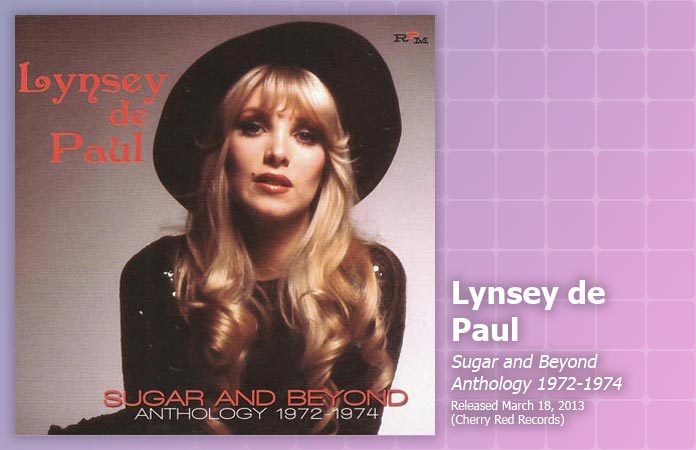
The entire ‘70s catalogue of pioneering female singer/songwriter Lynsey de Paul has finally been collected in two new anthologies: Sugar and Beyond 1972 – 1974 and Into My Music 1975 – 1979. Using exclusive material and information from Lynsey de Paul herself, this is a unique collection, signifying a new chance to discover her work and to grant it the recognition it deserves.
Waxing Nostalgic: The Pretenders, “Tattooed Love Boys”
Published on April 9th, 2013 in: Music, Teh Sex, Waxing Nostalgic |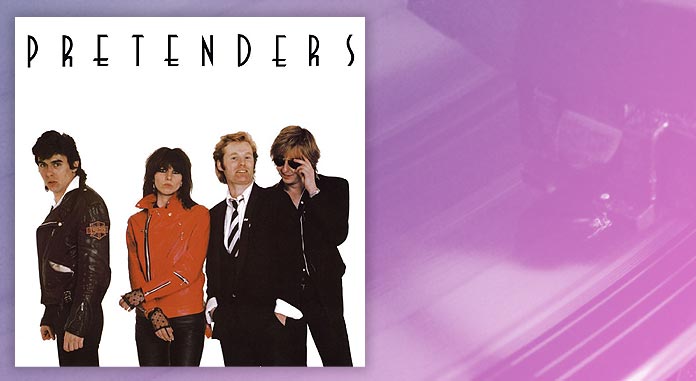
We have to talk about sex. I know this makes some folks uncomfortable. I’ll try to be gentle. However, if you are, or plan on, becoming a regular reader of this column (and golly, I hope you do), please realize this is going to happen once in a while. I write about music from the late Seventies and all throughout the Eighties. Those were formative years for me. Music is intertwined with those emotions and those memories. I would be surprised if the same were not true for you (and golly, I hope it is).
For instance: in the year 1980, I was eleven. Sweet, innocent, a little on the chubby side and completely unprepared for what was going to happen when she walked into my life. This woman would both destroy me and make me feel alive. She made me feel things . . . all the things. I had to look up words and ask other people—older people—what her phrases meant.
I’m talking about Chrissie Hynde.
Music Review: Todd Rundgren, State
Published on April 8th, 2013 in: Music, Music Reviews, Reviews |
Todd Rundgren has been making music since before most of us were born. His first solo album came out in 1969. He was huge during the early Seventies, riding the wave of his radio hit “Hello, It’s Me.” He resurged during the early Eighties as not only a musician, but as a video software pioneer. The video for “Time Heals” was everywhere back then. He resurged again in the Nineties, re-inventing himself as the first interactive musician, inviting folks to remix his tracks and play his music with him in his interactive music pod at PepsiStock ’94.
Then he started recording Samba versions of his old songs. This seemed to be a lateral move.