Music Review: Gudrun Gut, Wildlife
Published on January 24th, 2013 in: Current Faves, Feminism, Music, Music Reviews, Reviews |By Julie Finley
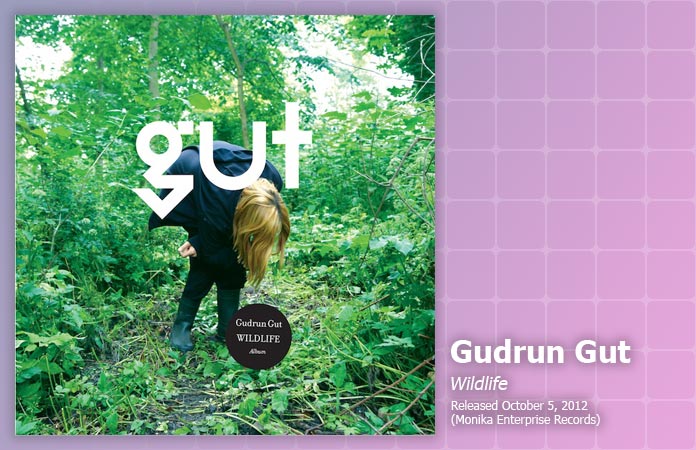
Wildlife is the new album by Gudrun Gut, released on Gudrun’s very own Monika Enterprise label. Her last musical outing prior to this was her collaborative project known as Greie/Gut Fraktion (a partnership with Antye Greie), but Wildlife is an actual solo outing (her second official solo album since I Put a Record On from 2007).
Wildlife is an exquisite collection of themes that are definitely in touch with nature. What I mean is that the focus is on nature in more than one context. No, this is not a tree-hugging manifesto; it has more to do with being aware of your surroundings, in a physical, as well as an emotional manner. It focuses on the vulnerability of humans, as well as all other living organisms.
Comments Off on Music Review: Gudrun Gut, Wildlife
Music Review: Buck Owens, Honky Tonk Man: Buck Sings Country Classics
Published on January 23rd, 2013 in: Current Faves, Music, Music Reviews, Retrovirus, Reviews, TV |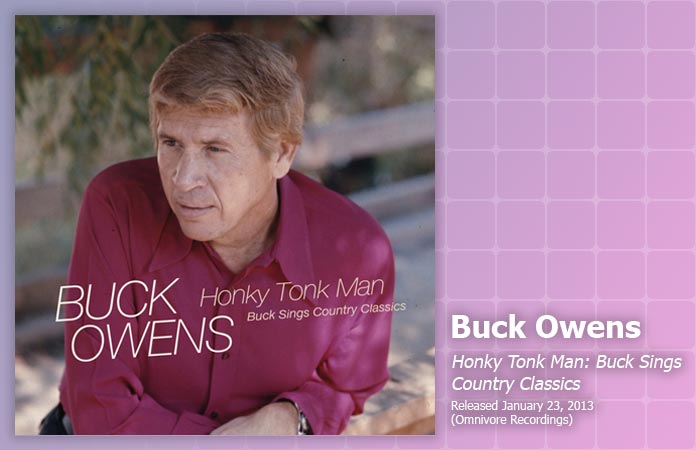
Another gem appears from the Buck Owens vault. Honky Tonk Man: Buck Sings Country Classics is a collection of musical backing tracks from Hee Haw with Buck’s reference vocals over them, which sounds like it wouldn’t be a treasure at all. But let me back up a moment.
Music Review: Don Rich Sings George Jones
Published on January 23rd, 2013 in: Current Faves, Music, Music Reviews, Retrovirus, Reviews, TV |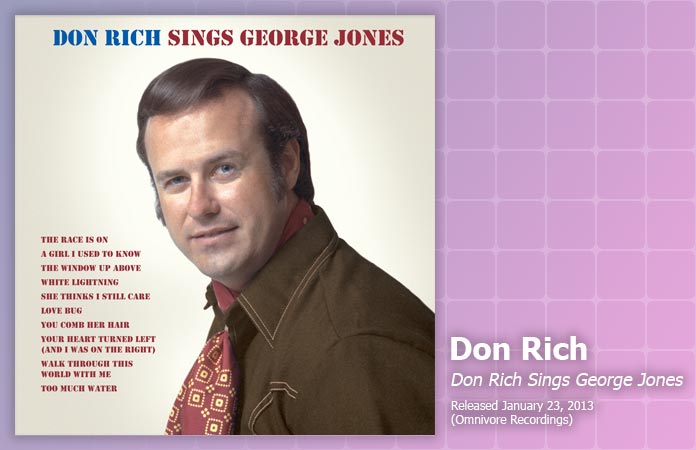
Some people fantasize about going to Shangri-La, some people dream of winning the lottery. Me? I dream of going to Buck Owens‘s tape vault. Until a couple of years ago, it never crossed my mind, but with 2011’s release of Buck Owens’s Bound For Bakersfield collection of pre-Capitol demos (review), and now with the dual releases of Don Rich Sings George Jones and Buck Owens’s Honky Tonk Man, I want to go there. I cannot get my head around the fact that Don Rich’s lone solo record languished in the vault for 40 years. I can’t help but wonder what’s left in there, and desperately want to find out.
Don Rich was Buck Owens’s right hand: his guitarist, fiddler, and the man who brought harmony—a high tenor over Buck’s high tenor—to his tracks. They had an uncanny, beautiful way of harmonizing. Don’s smiling presence on Hee Haw, just over Buck’s shoulder, is my favorite thing about the show. Okay. That sounds a bit like fan fiction. Note to self: Don’t look that up. Ever.
Music Review: Rosie Flores, Working Girl’s Guitar
Published on January 22nd, 2013 in: Current Faves, Feminism, Music, Music Reviews, Reviews |By Cait Brennan
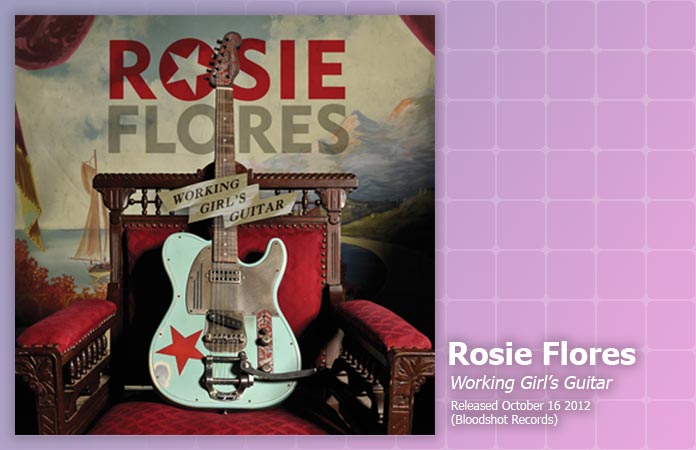
Rosie Flores is one of a kind. Fiercely independent, passionate, and soulful, Flores is a top-tier guitar virtuoso whose always-interesting work bridges blues and country; rockabilly and surf; and Southern California cowpunk and Tex-Mex to create her own strikingly original sound.
In the mid-’80s she fronted a great full-on Hollywood all-girl cowpunk outfit called the Screamin’ Sirens, but as fun as it was, it barely hinted at what was ahead. In 1987 Warner/Reprise released her solo debut, Rosie Flores, a pitch-perfect set produced by Dwight Yoakam’s producer and guitarist Pete Anderson. It was a brilliant pairing, and the record received near-universal praise from critics.
But despite the label’s effort to angle Flores as the female Yoakam, she was impossible to pigeonhole, and the following year she hightailed it to Austin, where she formed a new band featuring fellow luminaries like Junior Brown on pedal steel. Austin and Flores were nigh made for each other, and 1995’s Rockabilly Filly cemented Flores’s place in the firmament with a mighty collection of tunes featuring giants like Wanda Jackson and Janis Martin (the “Female Elvis,” whose work Flores has championed on many occasions.)
Flores is one of the finest guitarists alive, with nitro-fueled guitar solos that evince an expressiveness and fire that few of her contemporaries can match. Her custom “SteeltopCaster” guitar rings out like lightning on her new album Working Girl’s Guitar, a blazing set of rockabilly, rock, and blues classics interspersed with some fine new originals.
Music Review: Ty Segall & Mikal Cronin, Reverse Shark Attack (Reissue)
Published on January 22nd, 2013 in: Current Faves, Music, Music Reviews, New Music Tuesday, Reviews |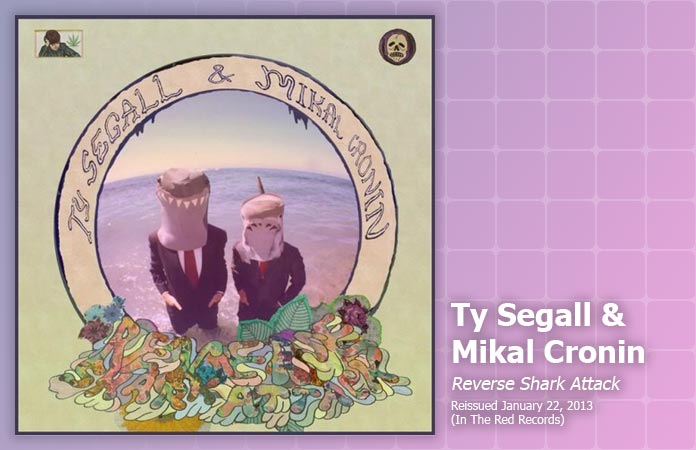
The second of two Ty Segall reissues, Reverse Shark Attack features Segall and his current touring bassist Mikal Cronin (who has quite a few releases with and apart from Segall). While just as dirty sounding as The Traditional Fools (review), these tunes are less garage rock and way more psychedelic, with brain-asplodin’ feedback that seems to lurch forth physically from the speakers.
It’s patently obvious that I’m going to be biased towards a song called “I Wear Black,” but it also happens to be good, snatching the heavy beat from “Wild Thing” and inserting a growling chorus of the song’s title.
Comments Off on Music Review: Ty Segall & Mikal Cronin, Reverse Shark Attack (Reissue)
Music Review: The Traditional Fools, S/T (Reissue)
Published on January 22nd, 2013 in: Current Faves, Music, Music Reviews, New Music Tuesday, Reviews |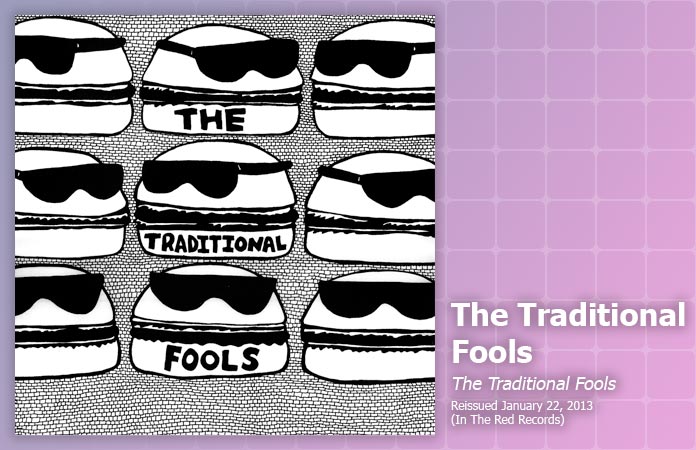
The prolific and talented Ty Segall has another album out today. It’s actually a reissue, but one that was previously only available on vinyl and has been out of print since its release. The Traditional Fools—comprised of Segall, Andrew Luttrell, and David Fox—put out only one album, but it’s killer. Its intensely dirty sound is more akin to Segall’s Slaughterhouse than Twins, but it is instantly loveable. It helps that despite the lo-fi recording, these guys were tight as hell.
The opening track, a cover of “Davey Crockett” by beloved legends Thee Headcoats, will either thrill or piss off fans of the original, but it’s obviously coming from a place of respect. It also sounds fantastic.
Comments Off on Music Review: The Traditional Fools, S/T (Reissue)
Music Review: Erin McKeown, Manifestra
Published on January 17th, 2013 in: Current Faves, Feminism, Music, Music Reviews, Reviews |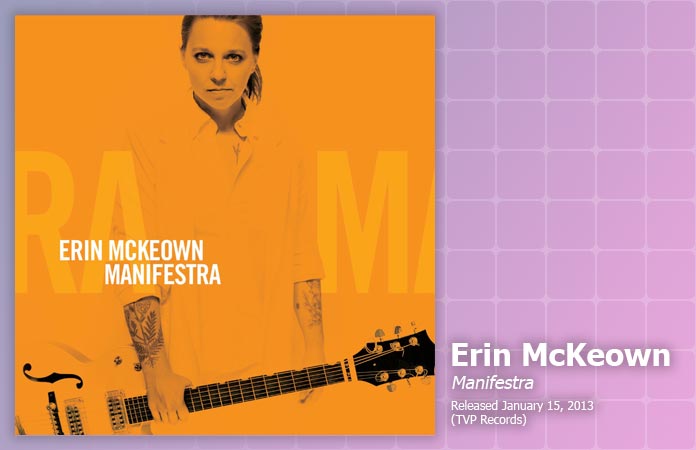
In 2012, musician/activist Erin McKeown made headlines for crowdfunding the production of her latest album, Manifestra. Unlike many artists whose crowd-sourced work becomes a three-ring circus, McKeown has strong musical bona fides. For almost two decades, the singer/songwriter has released a compelling body of work and dabbled in jazz, electronica, and folk. The spine of her work has always been her great skill at songwriting, which blends the tunefulness of Tin Pan Alley songwriters with her own irreverent charm, and her confident, minimalist guitar playing.
Manifestra extends the democratizing concerns of crowdfunding to some of her most explicitly political material to date. While I find many protest songs challenging—mostly because of the need to simplify complex issues into a three-minute time range and force them into a difficult format—McKeown escapes this trap by finding the human scale within the societal problems she describes.
Comments Off on Music Review: Erin McKeown, Manifestra
Music Review: Shoes, 35 Years—The Definitive Shoes Collection 1977-2012
Published on January 15th, 2013 in: Current Faves, Music, Music Reviews, Retrovirus, Reviews |By Cait Brennan
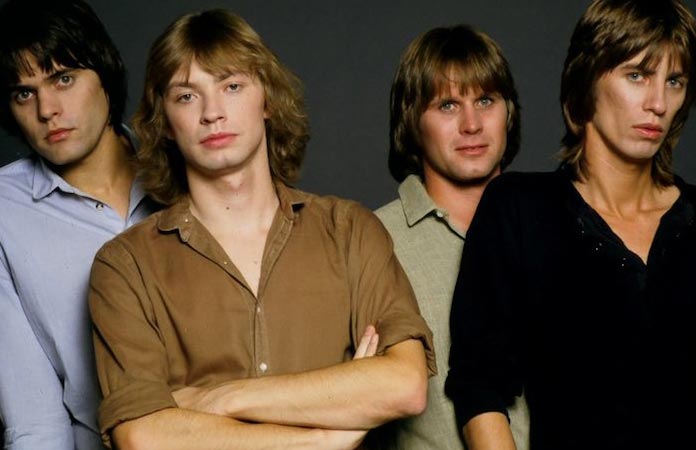
By any measure, 2012 was a banner year for the pioneering power pop rockers Shoes. For decades, the band has hewed its own indie path through pop music, with a strong DIY ethic that helped kick start the home-recording movement decades before Garageband made it easy. Back together in the studio for the first time in 17 years, brothers John and Jeff Murphy and their high school pal Gary Klebe joined with drummer John Richardson for Ignition, a spectacular new album of originals that reestablished Shoes as power-pop masters and made its way onto a number of critics’ year-end best-of lists (review). They were the subject of a new biography, Boys Don’t Lie: A History of Shoes, and their first four pre-Elektra albums—One In Versailles, Bazooka, Black Vinyl Shoes, and Pre-Tense (the Present Tense demos)—were issued on vinyl in gorgeous deluxe editions by the Numero Group.
Truly, it’s never been a better time to be a Shoes fan. But for those who haven’t yet joined the cult of Shoes, it might seem a little daunting to find a way in to a band whose widely acclaimed output stretches to at least 180 songs on 17 albums recorded over a 38-year period.
Real Gone Music has this problem sorted with its excellent new disc 35 Years—The Definitive Shoes Collection 1977-2012. From their ’77 breakthrough Black Vinyl Shoes all the way through Ignition, it’s a great survey of some of the finest moments of their career, and the perfect place to start a Shoes safari.
Comments Off on Music Review: Shoes, 35 Years—The Definitive Shoes Collection 1977-2012
Music Review: Crime & the City Solution, A History of Crime – Berlin 1987-1991: An Introduction to Crime & the City Solution
Published on January 9th, 2013 in: Current Faves, Music, Music Reviews, Retrovirus, Reviews |By Julie Finley

Being a longtime fan of Crime & the City Solution, I was already familiar with all of the tracks on A History of Crime. However, the albums in their discography aren’t easy to find, and are more than likely out of print, so if anyone ever had a fleeting interest in this band, but can’t get their hands on their albums, this release bridges that gap. A History of Crime is a grand collection of Crime & the City Solution’s works, and doesn’t disappoint. However, the one major flaw is that it only includes music created between 1987-1991. I mention this because the pre-1987 output contains some of my favorite songs.
Comments Off on Music Review: Crime & the City Solution, A History of Crime – Berlin 1987-1991: An Introduction to Crime & the City Solution
Music Review: Django Unchained Original Motion Picture Soundtrack
Published on December 21st, 2012 in: Current Faves, Music, Music Reviews, Soundtracks and Scores |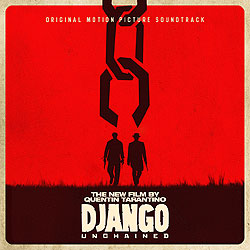
Audiences know by now that the films of Quentin Tarantino will have certain elements in common: protagonists that barely edge out of antihero territory, if at all; bad guys at least as charming as the heroes, but lacking in fundamental compassion; gleefully creative use of extreme profanity, either in dialogue or in philosophy; and of course, extreme, explicit, and shocking violence. Something often overlooked, however, until experienced, is the fact that Tarantino is one of the most gifted compilers of phenomenal soundtracks that has ever lived.
Comments Off on Music Review: Django Unchained Original Motion Picture Soundtrack