Fate And Fault In A Ford Pinto: The Everyday Horror Of Cujo
Published on September 29th, 2011 in: Books, Halloween, Horror, Retrovirus |By AJ Wood
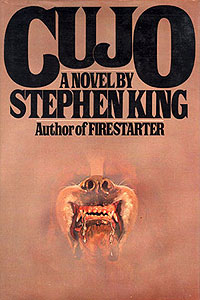
On a recent warm summer night I was re-reading my favorite Stephen King novel, Cujo, by the open window. Just as King was describing how the foamy-mouthed mangy dog was munching into a man’s throat with quite serious OM NOM NOM gusto, my cat decided to come to the window and play a little joke on me.
“Meow?” he said in his meanest, growlingest voice (at least as I heard it).
“AHHHHHHH!” I replied, my body jolting, nearly tossing my e-book across the room.
Two important things I learned that evening: 1) the same stuff I use to clean up the cat’s pee works well at cleaning up my own accidents and 2) exactly what it is about Cujo that really scares the bejeezus out of me.
< (more…)
Comments Off on Fate And Fault In A Ford Pinto: The Everyday Horror Of Cujo
The Haunter Of The Dark: Horror In Radio
Published on September 29th, 2011 in: Books, Halloween, Horror, Radio, Retrovirus, Science Fiction |By Paul Casey
“It. Is. Later. Than. You. Think. Lights Out brings you stories of the supernatural and the supernormal, dramatizing the fantasies and the mysteries of the unknown. We tell you this frankly. So if you wish to avoid the excitement and tension of these imaginative plays, we urge you, calmly, but sincerely to turn off your radio, now. And now, Lights Out, everybody.”
Comments Off on The Haunter Of The Dark: Horror In Radio
Everything Undead Is New Again: Are Vampires Still Vicious?
Published on September 29th, 2011 in: Books, Comics, Halloween, Horror, Movies, TV |By Kai Shuart
So, I’m just going to get down to the nitty-gritty: I love me some vampires. They’re violent, they’re sexy, and they’re transgressors of any religious, sexual, or social mores a mortal can think up. And they have the power to give that power to anyone they see fit.
But I am a vampire snob. Don’t come across my way with any of that Stephenie Meyer weak sauce; give me Eli from Let The Right One In, Anne Rice’s Lestat, Cassidy from The Preacher comics, Buffy’s Dru or Spike, or even Barnabas Collins from Dark Shadows (a callous hedonist turned vicious killer vampire turned tortured hero . . . yeeeah, with all due respect to Joss Whedon, the archetype didn’t start with a certain billowy-coated King of Pain). To me, a vampire is first and foremost a killer, and a gleeful one at that. Well, we should all take pride in our work . . .
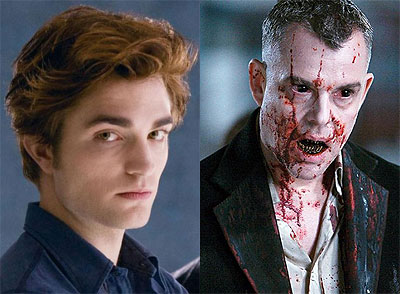
Twilight vs. 30 Days Of Night
I couldn’t help but wonder, though: why does each successive interpretation of what a vampire is and what a vampire does seem so tame compared to the early pop culture incarnations set forth by people like Bram Stoker and F.W. Murnau? This is a monster whose father was Vlad the Impaler, one of the bloodiest, most sadistic dictators who ever walked the face of the Earth; and whose mother was Elizabeth Bathory, a woman who threw orgies and bathed in virgin’s blood because she believed it kept her youthful. Now they sparkle? All snark aside, I had to ask how this shift took place.
Upon consideration, I think part of this comes from a very human need to make friends with what scares us. The thinking goes that if we somehow forge a connection with the monsters (both literal and figurative) that keep us awake at night, the monsters will eventually overcome their natures and spare our lives. This is exactly how the romances play out in modern vampire lore: Twilight’s Edward can smell Bella’s blood a mile away, but doesn’t do the deed because he loves her so much. (This is me. Retching.) In True Blood, there’s something in Sookie Stackhouse’s blood that drives vampires crazy, but Bill Compton protects her from some of his more primal cohorts. To be fair, there’s a lot of this dynamic between Oskar and Eli in the book Let Me In, but at least there’s a question of whether protecting Oskar wasn’t just a by-product of Eli procuring a meal.
The fact that vampires have grown significantly less vicious and amoral as time has gone on could also be because it plays into the rather marketable notion that a good woman can reform a bad boy. Even though Buffy the Vampire Slayer has many, many positive points, even that great show is guilty of this. In the third season, Angel is somehow brought back from the hell dimension to which Buffy sent him after his reversion to his evil Angelus form. In this form, he psychologically tortured Buffy through attacking—and in the case of Jenny Calendar, killing—Buffy’s allies.
After Angel’s return, Buffy finds him in an extremely feral state. But what does our heroine do? Instead of thinking that maybe she was a bit justified in killing her former lover and sending him to hell, she is convinced that the Angel she loved is still in there somewhere. Because of this, she makes it her mission to tame him through regular visits during which she feeds him, reads to him, and does Tai Chi with him.
A final reason for these shifting interpretations of vampires could be the political climate. The massively popular Twilight series was first published during the Bush administration, a period in which everything seemed oriented towards conventional sexual mores. Sure enough, Bella and Edward don’t have sex at all until they’re lawfully wed.
By contrast, Anne Rice’s Interview with the Vampire was released in 1976, within a much more liberal environment that was likely influenced by the attitudes of the previous decade. This could account in some small part for the fact that a story that features Lestat, a sybaritic, gleeful killer vampire who makes no bones about how much he enjoys being a vampire, sold so well. Also, Rice was much less squeamish about the homoerotic elements of her story. For example, as melancholy as he is, Louis finds a “companion” in fellow vampire Armand. It’s not explicitly stated that the two are lovers, but there is certainly ample room for that interpretation.
Regardless of whether these shifts have come about due to political climate, human nature, or the marketing of gendered relationship roles, one thing is for certain: I will keep taking my vampires straight up. Fortunately for me and other like-minded individuals, a much more animalistic interpretation of the vampire has recently been coming into prominence, quite possibly in response to the vampire’s role as the dark, sexy, forbidding romantic figure.
Vampires in the film and comic 30 Days of Night, with their ghostly faces and mouths full of razor-sharp teeth, have a purely animal instinct to kill rather than seduce their prey, and they certainly don’t worry about how killing people affects the state of their immortal soul. Proving that everything comes full circle, this seems to be reverting to the much earlier pop culture incarnations of vampires, borrowing the gnarled claws and batlike visage from Murnau’s Nosferatu.
Will this interpretation eventually overtake its sparkly, more tween-friendly counterpart? Time will tell, but I for one really hope so . . .
Comments Off on Everything Undead Is New Again: Are Vampires Still Vicious?
Livide, A Film by Julien Maury and Alexandre Bustillo
Published on September 13th, 2011 in: Horror, Movie Reviews, Movies, Reviews |
It’s young Lucie’s first day as a trainee in-house caregiver. She visits Mrs Jessel, an old woman who lies in cerebral coma, by herself, in her large desolate house. Learning by accident that Mrs. Jessel, a former dance teacher of repute, supposedly possesses a treasure somewhere in the house, Lucie and friends William and Ben decide to search the house in the hope of finding it. At night, they get into the house, which reveals itself to be increasingly peculiar. Their hunt for Mrs. Jessel’s treasure leads them into a horrifying supernatural series of events that will change Lucy forever . . .
Don’t Be Afraid Of The Dark
Published on August 26th, 2011 in: Canadian Content, Current Faves, Horror, Movie Reviews, Movies, Reviews |
Horror fans of a certain age surely remember the 1973 TV movie Don’t Be Afraid Of The Dark. To me, it was always known as “the movie about the things in the fireplace,” which was enough to keep a scaredy-cat kid away for many years. Although I didn’t see it until more recently, I quickly became a big fan; the movie still provides plenty of genuinely creepy moments which make me glad I never saw it as an impressionable youth.
Filmmaker Guillermo del Toro, who produced the terrific remake that’s out today in theaters, has called the original “the most terrifying on earth.” But the new Don’t Be Afraid Of The Dark isn’t a movie full of jump scares like the also-terrific Insidious, which came out earlier this year. It’s more of an old-fashioned haunted house movie, where the unease and dread build slowly and inexorably towards a horrible climax.
Comments Off on Don’t Be Afraid Of The Dark
It’s Not Nice To Fool Mother Nature: Tarantula, Piranha, Inseminoid
Published on May 30th, 2011 in: Climb Onto The Nearest Star, Feminism, Horror, Issues, Movie Reviews, Movies, Science Fiction, Underground/Cult |This article originally appeared in The So Bad It’s Good Movies Fanzine, Issue #2.
Godzilla (1954) is perhaps the first horror movie to depict the dire consequences of tinkering around with nature, and it inspired decades of thematic impersonators. Although it warned of the dangers inherent in the H-bomb, as environmental and sociopolitical concerns transformed, so did the types of movies which addressed these issues.
American films from the 1950s, such as Them! (giant killer ants), Beginning of the End (giant killer grasshoppers), and The Creature From The Black Lagoon (killer fish/man/beast) all point out how “tampering in God’s domain” (to paraphrase MST3K) can really screw things up.
But what about the womenfolk? How do they fit into this? From Tarantula to Piranha to Inseminoid, let’s look at what happens when we try to fool Mother Nature.
Comments Off on It’s Not Nice To Fool Mother Nature: Tarantula, Piranha, Inseminoid
There Is No Alfred, Only Proteus: Demon Seed
Published on May 30th, 2011 in: Climb Onto The Nearest Star, Horror, Issues, Movie Reviews, Movies, Science and Technology, Science Fiction |Although technophobia has been around since the Industrial Revolution, the advent of computers in the 1960s and ’70s introduced a new level of fear into citizens of industrialized nations. Those under the age of 40 may scoff that anyone could possibly be afraid of a computer, but when they talk? That’s a different story.
Comments Off on There Is No Alfred, Only Proteus: Demon Seed
The Color Out Of Space: The Films Of H.P. Lovecraft
Published on May 30th, 2011 in: Climb Onto The Nearest Star, Horror, Issues, Movies, Science Fiction |By Paul Casey
Guillermo del Toro will not make At the Mountains of Madness, at least not anytime soon. Perhaps our only chance of the first great cinematic interpretation of H.P. Lovecraft’s Cthulhu mythology has been thwarted. Do not fear dear reader, all is not lost! I am here to tell you that while we lack that perfect vision of Cthulhu and his aquatic features, there are many adaptations of his work that should please the casual and hardcore Lovecraft fan.
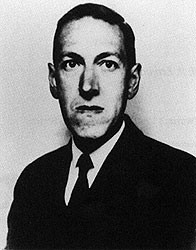
H.P. Lovecraft
Comments Off on The Color Out Of Space: The Films Of H.P. Lovecraft
The Women Behind The Whedonverse
Published on March 30th, 2011 in: Back Off Man I'm A Feminist, Feminism, Gaming, Horror, Issues, Magick, Movies, Science Fiction, The Internets, TV |By Lisa Anderson

Even casual fans of Joss Whedon know that strong female characters are important to him. Buffy the Vampire Slayer, Echo from Dollhouse, and Zoe from Firefly are only a few examples. What casual fans may not realize is that women behind the scenes—Whedon’s fellow writers and producers—have also helped make his storylines beloved to so many fans. They include Jane Espenson, Marti Noxon, Maurissa Tancheroen, and Felicia Day.
(more…)
I’m The Real Victim Here: I Spit On Your Grave Remade and Revisited
Published on March 30th, 2011 in: Back Off Man I'm A Feminist, DVD, DVD/Blu-Ray Reviews, Feminism, Horror, Issues, Movie Reviews, Movies, Reviews |By Michelle Patterson
Victimhood has had an ironic stranglehold on cinema since the medium’s very inception. The “woman’s picture,” along with the romantic comedy and action-adventure genres, tap into the potential for an audience to live both vicariously through the film and also fully explore their empathetic side. The horror film has also allowed this to continue for over a century now.
(more…)
Comments Off on I’m The Real Victim Here: I Spit On Your Grave Remade and Revisited