The Age of Permanent Prosperity: Spotify is the Greatest Thing
Published on February 12th, 2013 in: Current Faves, Music, Science and Technology, Streaming, The Internets |By Paul Casey

When I had a talk before about why compilations needed to die, I was concerned about their tendency to solidify tastes rather than challenge them. I would stick to a handful of albums and obsess about arranging them, producing classy covers, and finding people to absorb my musical missives in good humor. Even though I have made attempts every few years to shake myself up and haul in new music to replace old, it was still such a costly exercise that I was rarely satisfied.
For those who have had Spotify available to them for several years, please forgive me for pointing out the obvious: It is possibly the greatest thing ever. Here in Ireland, being a largely backwards outfit, we have only recently been given the chance to put an ear towards such a severe streaming catalogue.
Ten euro a month is nothing for the quality of the service provided. Twice as much could be charged and it would still be an obscene bargain, especially for those humans who are still attached to the idea that financial recompense is a fair deal for created things. There are problems and quirks with Spotify of course, and a lingering question over whether this kind of subscription service can ever provide a living for artists. Seeing as the Internet has made solipsism the thing with music, I will ignore these for the moment and expand on how I have personally benefited from this service.
Comments Off on The Age of Permanent Prosperity: Spotify is the Greatest Thing
Music Review: Goblin, The Awakening (box set)
Published on February 8th, 2013 in: Current Faves, Horror, Music, Music Reviews, Retrovirus, Reviews, Soundtracks and Scores |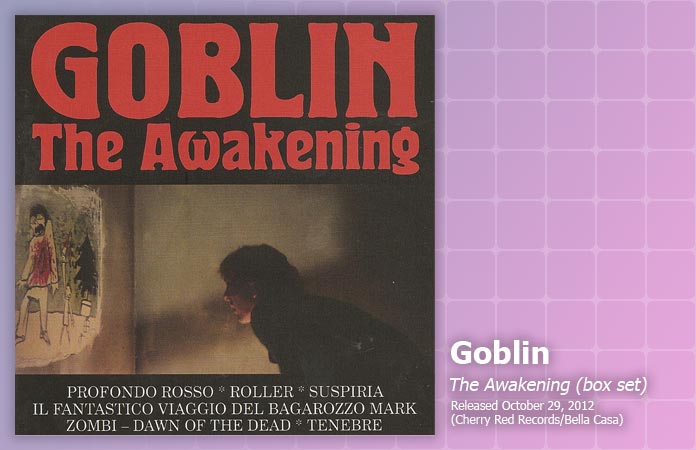
If you’ve seen Suspiria, then you know of Goblin, the Italian band responsible for its iconic, eternally terrifying score. There have been lineup changes over the years, but several members have been consistent: original members Massimo Morante and Claudio Simonetti, in addition to Maurizio Guarini, Agostino Marangolo, Walter Martino, and Fabio Pignatelli.
Fans of filmmaker Dario Argento may already be familiar with Goblin’s contributions to the Italian horror and giallo genres, but Goblin has much to offer the music aficionado looking for something challenging. In keeping with the spirit of their prog rock origins, they have several albums that are not scores, including at least one straight-up concept album, sort of like a soundtrack without a movie.
Cherry Red Records and Bella Casa have compiled an excellent sampling of Goblin’s bizarre and enthralling discography with a six-disc box set including not only the band’s compositions for Argento films, but also their contributions to the prog rock pantheon.
Comments Off on Music Review: Goblin, The Awakening (box set)
Music Review: Mary Gauthier, Live At Blue Rock
Published on February 7th, 2013 in: Current Faves, Feminism, LGBTQ, Music, Music Reviews, Reviews |By Cait Brennan
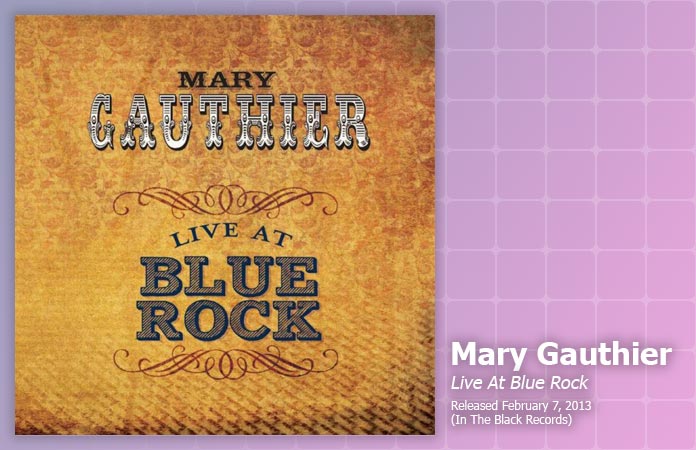
There’s probably never been a more honest songwriter than Mary Gauthier. From her earliest days in music, taking up songwriting after becoming sober at 35, she’s created characters whose struggles—with adoption, addiction, sexuality, homelessness, rootlessness—have closely mirrored her own. The road can be rough, but Gauthier’s an expert in finding the spark of hope in the saddest of situations.
Over six studio albums, commencing with 1997’s Dixie Kitchen, Gauthier’s proven herself to be a storyteller of the first order. If the mood ever hits her, she’d be as great a novelist as she is a songwriter. Worlds rise and fall in her songs. Her characters reach grasping hands out of the cold darkness for one last shot at redemption. They grab it, sometimes. Sometimes it slips away.
Her songs have been covered by everybody from Blake Shelton to Boy George, and while you ponder that mental image, know that nobody’s done ’em better than Gauthier herself.
It took her a long time to record a live album, but the outstanding songs and powerful performances on Live At Blue Rock prove it was worth the wait. Recorded live at Blue Rock Artists Ranch in Austin, Live At Blue Rock presents 11 of her finest, eight of which were written or co-written by Gauthier.
Miercoles con Víctor Jara: Una Introduccion
Published on February 6th, 2013 in: Culture Shock, Current Faves, Music, Retrovirus |
Time stopped when I first heard Víctor Jara sing. One of my favorite podcasts, Alt.Latino, had included Jara’s music in an episode that looked at protest music from across Central and South America. Jasmine Garsd, the podcast’s co-host, had preceded his song with a description of his importance in his native Chile and his brutal murder at the start of the Pinochet regime. As disturbing and poignant as this biography was, nothing prepared me for the beauty of his music.
The needle dropped on “Un Derecho de Vivir en Paz,” Jara’s song in protest of the Vietnam war. Over a bed of harpsichord and arpeggiated guitar, Jara sang in a disarmingly straightforward voice. His tenor had a reedy tone and a substantial quality that anchored the melody. Like many of its North American counterparts, the song had a memorable melody that could invite singalongs. Where many songwriters north of the border tended towards straightforward production however, Jara’s song featured a psychedelic instrumental break in which a ragged guitar freakout alternated with a bobbling analog synth part. The song ended with what sounded like a spontaneous choir of “la la la”s, which reinforced the spirit of community for which Jara’s time was known. As understated as Jara sounded, a current of sadness and hope ran through his voice, and that emotion made me want to listen to it again and again.
After hearing about his grotesque death, I found myself wanting to see Jara as he was alive. Some excerpts from a live concert he performed for Chilean television came up on YouTube. Seeing and hearing this man, with his steady, weathered voice and his everyman appearance, made him more real for me but also made the tragedy of his death that much more palpable. I was drawn to the honesty of his voice and the lyrics I could understand, but the experimentation in his music beguiled me as well.
In time, I was able to get a boxed set of Jara’s albums through inter-library loan, as well as a copy of An Unfinished Song, the biography his wife Joan wrote about him. I also have been attempting to read The Shock Doctrine to better understand the Allende administration and how Pinochet came to power. Through my interest in Jara I learned that two bands I quite like have paid tribute to him in song—Joe Strummer name-checked him on Sandinista! and Calexico recorded a song called “Víctor Jara’s Hands.”
In spite of these tributes and the praises of other big-name fans, Jara is not well known in the States. To that end, I will be working through his discography and writing reviews for Popshifter when time permits. Víctor Jara created music that both spoke to the people of its day and is still prescient in this day and age. His work deserves a larger audience and I’d like to do what I can to encourage readers to track down his music.
Comments Off on Miercoles con Víctor Jara: Una Introduccion
Music Review: Townes Van Zandt, Sunshine Boy: The Unheard Studio Sessions & Demos, 1971- 1972
Published on February 6th, 2013 in: Current Faves |By Cait Brennan
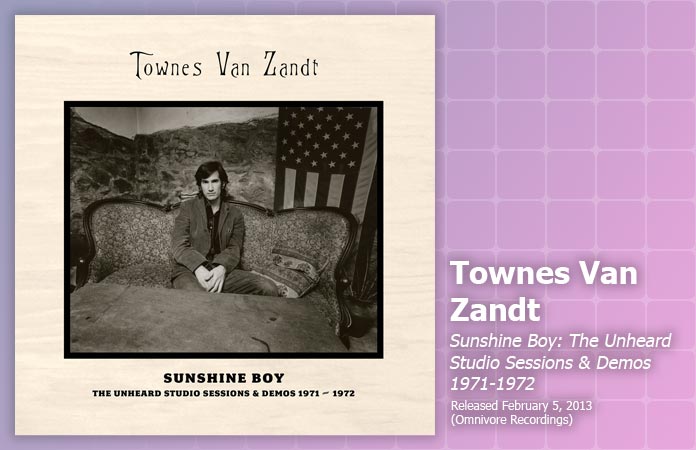
Townes Van Zandt burned through his short life like beads of water dancing on a hot frying pan, looking for a way out, struggling to fly, trying to take off for pretty much anywhere else. He occupied this earth for 52 years and for most of it he was in unbearable psychic pain. He self-medicated, but the treatment was worse than the disease. But from time to time, especially during the early-to-mid-1970s, he was able to transform a measure of that pain into songs of almost unparalleled beauty.
On New Year’s Day 1997, Townes slipped away, leaving us a handful of studio albums that have acquired near-legendary status. But some of those recordings are deeply flawed by poor production choices, and even the great ones have at times been hard to find. The idea of finding new Townes material after 40-plus years seemed impossible. But impossible is all in a day’s work for the good folks at Omnivore Recordings, who moved heaven and earth to bring us 28 lovingly curated tracks of never-before-heard Townes music, Sunshine Boy: The Unheard Studio Sessions & Demos 1971-72.
Music Review: Hayden, Us Alone
Published on February 5th, 2013 in: Canadian Content, Current Faves, Music, Music Reviews, New Music Tuesday, Reviews |By Emily Carney
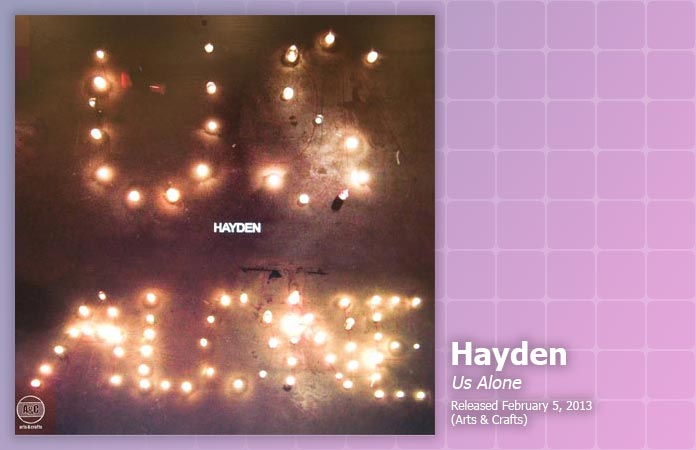
Toronto’s Hayden Desser released one of my favorite indie rock albums in 1996, Everything I Long For. It has aged remarkably well, given that it was produced in the mid-1990s (let’s face it; music did have a specific sound then, even though we didn’t realize it at the time). It occupied a prominent place in my CD collection (remember CDs?), next to Sebadoh’s III and Pavement’s Wowee Zowee. I’ve lost track of Hayden over the years, but just caught up with his music by listening to his newest release, Us Alone. It’s like saying hello to an old friend who has gotten older and might be having a slight nervous breakdown, but I mean that in the best possible way.
Tracks like “Instructions” and “Just Give Me a Name” are moody and slow, very much in tune with some of Hayden’s 1996 tracks. The more uptempo tracks, including “Rainy Saturday” and “Blurry Nights” have a Neil Young-esque quality to them—lots of guitar effects, plaintive vocals, and slightly country-ish flourishes. This album is not a radical departure for Hayden by any means; it’s more like a whisper in the dark than a sonic boom.
That being said, it’s recommended listening. It has a “sweet and low” quality, similar to Yo La Tengo. It’s perfect listening for the party after the party, where you’re drunk, emotionally overwhelmed and exhausted.
As some things get older, some things stay the same—while it seems Desser is in a happy relationship, he’s still a bit mournful. Adulthood does that to you.
Us Alone is out today from Arts & Crafts and is available to order from the label’s website. You should also check out Hayden’s website at http://wasteyourdaysaway.com.
Tour Dates:
2/6: Kingston, ON @ The Grad Club
2/7: Guelph, ON @ Cooperators Hall SOLD OUT
2/8: Hamilton, ON @ The Dundas Valley Montessori School SOLD OUT
2/9: Avening, ON @ Avening Community Centre SOLD OUT
2/13: New York City, NY @ Mercury Lounge*
2/20: Toronto, ON @ The Dakota Tavern SOLD OUT
2/21: Toronto, ON @ The Cameron House SOLD OUT
2/22: Toronto, ON @ Rivoli* SOLD OUT
3/7: Wakefield, QC @ Blacksheep Inn*
3/8: Montreal, QC @ La Sala Rossa*
3/13: Austin, TX @ SXSW
3/17: Denver, CO @ Hi Dive*
3/20: Seattle, WA @ Tractor Tavern*
3/21: Portland, OR @ Doug Fir Lounge*
3/23: Vancouver, BC @ The Rio Theatre*
3/24: Nelson, BC @ The Royal on Baker*
3/26: Edmonton, AB @ The Royal Alberta Museum Theatre*
3/27: Calgary, AB @ Festival Hall*
3/28: Saskatoon, SK @ The Bassment*
3/30: Winnipeg, MB @ West End Cultural Centre*
4/3: Chicago, IL @ Schubas*
6/8: Toronto, ON @ Arts & Crafts 10th Anniversary Field Trip
* with special guest Lou Canon
Comments Off on Music Review: Hayden, Us Alone
Music Review: Chris Stamey, Lovesick Blues
Published on February 5th, 2013 in: Current Faves, Music, Music Reviews, New Music Tuesday, Reviews |By Cait Brennan
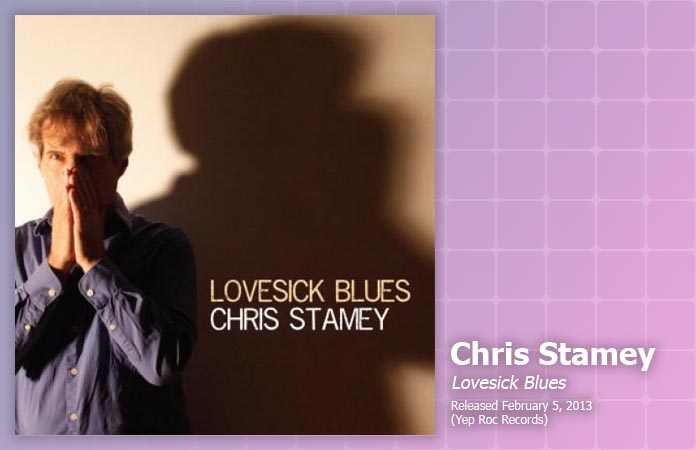
Just about any item on Chris Stamey‘s resume would get you your cult rock and roll bona fides. He played with Big Star’s Alex Chilton, and formed his own great (if short-lived) powerpop band Sneakers alongside Mitch Easter and Will Rigby. Stamey even founded his own indie record label, which released the one and only solo single by Big Star’s Chris Bell, the transcendent “I Am The Cosmos.” But he was just getting started.
Perhaps best known as a founding member of influential rockers the dB’s, Stamey cemented his place in music history early with that band’s first two landmark albums, 1981’s Stands For Decibels and 1982’s Repercussion. But despite the acclaim, Stamey stepped out for a solo career shortly before the band’s third album Like This, and has traveled a fiercely independent road ever since.
The past few years have found Stamey busier than ever. He’s produced records for artists as diverse as Yo La Tengo, Whiskeytown, Le Tigre, and Alejandro Escovedo, recorded duo albums with his former dB’s compatriot Peter Holsapple, and even served as the driving force behind the acclaimed Big Star tribute shows, fully-orchestrated live performances of Big Star’s Third/Sister Lovers.
In 2012, 30 years after leaving the band, Stamey and the dB’s reunited for an outstanding new album, Falling Off The Sky, a blazing rock record that sounded less like a reunion of old pals and more like the debut of a vital new band (review). And now, before the ink’s even dry on Falling Off The Sky‘s strong reviews, Stamey’s back with a complete about-face, a warm, intimate solo collection of new songs called Lovesick Blues.
Comments Off on Music Review: Chris Stamey, Lovesick Blues
Music Review: Richard Thompson, Electric
Published on February 4th, 2013 in: Current Faves, Music, Music Reviews, Reviews |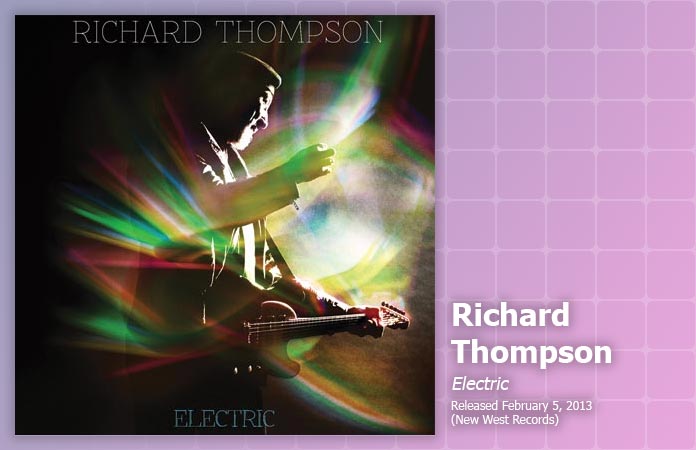
At this point in Richard Thompson‘s life, his legacy is assured. As one of the members of British folk band Fairport Convention, he played a role in bringing together traditional Celtic music, folk rock, and psychedelia, and his albums with former wife Linda are some of the most melancholic and offhandedly cathartic albums of their time. As a songwriter, Thompson has a mordant wit and a great sense of melancholy. His guitar work brings together several different styles and approaches, but unlike his contemporary Eric Clapton, his real skill is in the notes he doesn’t play. In short, one could forgive him for coasting.
To some extent, Electric picks up where Thompson’s previous album Dream Attic left off (review). While he doesn’t appear to be playing these songs before a live studio audience, this latest album at least sounds as though it was recorded live, with all the members of the band in the same room. While the stripped-down arrangements, with their focus on Thompson’s electric guitar solos, find him in his comfort zone, the lyrical content seems a bit angrier and more immediate than much of his previous work.
Comments Off on Music Review: Richard Thompson, Electric
DVD Review: Compliance
Published on January 31st, 2013 in: Current Faves, DVD, DVD/Blu-Ray Reviews, Movie Reviews, Movies, Reviews |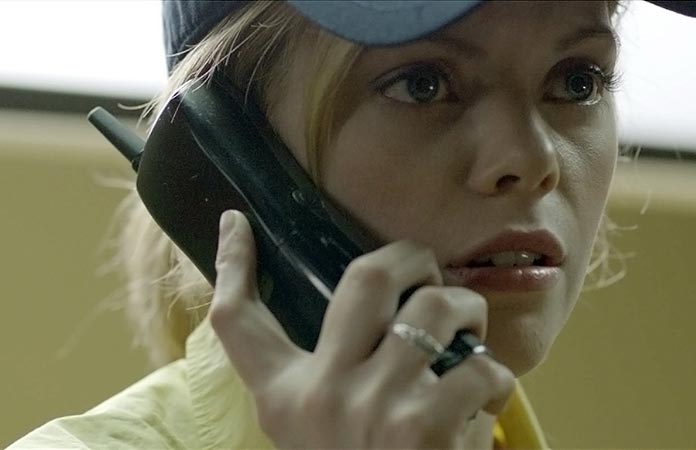
It’s difficult to review a movie like Compliance. Usually the tag line, “Inspired By True Events” signals a couple of hours of cinematic hyperbole. Even documentaries aren’t immune from altering or omitting facts to suit the filmmakers’ agenda(s). What’s most disturbing about Compliance is how scenes that might trigger the viewer’s bullshit meter actually did occur. While much of the dialogue used to illustrate the events may have been created, the scenarios themselves are real.
Anyone who has worked in a fast food restaurant (or as industry parlance prefers, a “quick-service restaurant”) might immediately feel discomfort during the opening scenes of Compliance, not because of any horrific events taking place, but because of the remarkably authentic atmosphere of what takes place in those environments.
Comments Off on DVD Review: Compliance
Movie Review: The Sessions
Published on January 31st, 2013 in: Current Faves, Movie Reviews, Movies, Teh Sex |By Maureen

TM and © Twentieth Century Fox Film Corporation. All Rights Reserved.
I knew very little about The Sessions going into it. I knew that it was about a man suffering from polio (John Hawkes) who hires a woman to have sex with him. That was enough to pique my curiosity, and so I watched it.
The Sessions is based on the life of a real-life man, Mark O’Brien, who contracted polio at a young age and has to spend all but about four hours per day inside an iron lung to keep him breathing. Even when outside this device, he is required to remain flat on his back on a gurney with portable oxygen.
He manages to work his way through an English degree at Berkeley, and when the story picks up in 1988, he is 38 years old and working from home as a poet and occasional journalist. He’s contacted about a news story about sex and the disabled, and his quest for professional research opens a world of personal doors and discoveries for him.
Comments Off on Movie Review: The Sessions