Bigger Than Us: Q&A With White Lies
Published on January 30th, 2011 in: All You Need Is Now, Current Faves, Issues, Music, Q&A |By Jim R. Clark
If you haven’t listened to White Lies’ debut album, To Lose My Life yet, well then, what are you waiting for? Now is the time. Their new album, Ritual, was released on January 18. Much like reading chapter two in a great novel, you won’t want to forge ahead without reading chapter one first.
As you may know from reading my previous articles, I’m an avid fan of the ’80s electronic sound, so I’m excited. Personally I’m still hoping for a cover of Alphaville’s 1985 song, “A Victory Of Love,” but I think that may be asking too much. (For some reason, I’m convinced that this song would make for an awe inspiring show stopper if given the White Lies treatment, but then again, that’s just me.)
White Lies just completed a few dates in the US and North America (sadly, their NY show was canceled due to a snowstorm) and has scheduled a British tour in February to promote Ritual, so if you’re reading this in Britain, then get up and buy some tickets. And if, like me, you’re not in Britain, try to catch them on Later . . . with Jools Holland reruns on BBC America.
The band took some time out from their busy touring schedule to answer a few of my burning questions and shed some light upon their dark and mysterious nature, hinting at the more electronic sound for their second album.
(more…)
Painters Paint: The Definitive Career-Spanning Interview (to date) With The High Llamas’ Sean O’Hagan
Published on January 30th, 2011 in: All You Need Is Now, Current Faves, Interviews, Issues, Music |By John Lane
For the uninitiated, The High Llamas are an enduring band that emerged in the early ’90s. Sidestepping the twists and turns of the teenage-angst/grunge bandwagon propagated by the media because of Nirvana, the Llamas hoed their own row and followed the credo that sometimes a small sound can make its own huge explosion. They were armed with banjos, vibraphones, strings, and a savvy musical sensibility that embraced everything from Bacharach to Bizet.
I first came across the High Llamas circa 1997 when a friend of mine (knowing of my love of The Beach Boys’ Pet Sounds) asked me if I had heard of them. I didn’t, so he made me a tape copy of their album Hawaii, which I proceeded to play ad nauseum on a small General Electric radio/tape-player the night before a wedding. I was the groom’s best man, and after about ten listens of the epic album, he politely asked if I could spin something else. I grudgingly obliged, but can’t remember what the substitute was.
I was thrilled to get the chance to prod the brain of High Llama guitarist and songwriter Sean O’Hagan.
(more…)
The Adventures Of Miss Flitt: Q&A With Designer Beth Hahn
Published on January 30th, 2011 in: All You Need Is Now, Art, Books, Culture Shock, Current Faves, Feminism, Issues, Q&A |By Chelsea Spear
In the late 2000s, knitwear designer Beth Hahn took the knitting world by storm with her series, The Adventures of Miss Flitt. Blending steampunk-friendly Victorian style, elegant knitwear designs, and an addictive narrative, the series follows the adventures of Emma Flitt as she traverses 19th century Brooklyn to find her sister. Her travels take her to seedy vaudeville theaters, pickpockets’ dens, and—in the most recent edition—to a most spooky séance. Ever the master storyteller, Hahn weaves her story through a series of simple-yet-gorgeous and thoroughly wearable cardigans, berets, overskirts, and other accessories.
On a chilly weekend in early January, I took virtual tea with Beth Hahn to find out more about her knitting endeavors.
(more…)
Comments Off on The Adventures Of Miss Flitt: Q&A With Designer Beth Hahn
A Goddess At The Console: Q&A With Mary Edwards
Published on January 30th, 2011 in: All You Need Is Now, Current Faves, Feminism, Issues, Music, Q&A |By John Lane
In another era, Mary Edwards might have been a behind-the-scenes songwriter in the famous Brill Building, that renowned stable of musical artisans that included Goffin & King, Laura Nyro, and a host of others. Instead, in this era, we are lucky to have singer/songwriter Mary Edwards in clear view. Her music is characterized by a smooth charm that draws upon soft-pop, jazz, and funk, framed with a soulful voice that is reminiscent of Dionne Warwick in her prime; her attitude reflects an almost guileless enthrallment with music and the sometimes subtle, gifted influences that can become songwriting fodder. I caught up with Mary upon the recent release of her latest album, Console.
(more…)
Destroy All Movies!!! The Complete Guide To Punks On Film
Published on January 30th, 2011 in: All You Need Is Now, Book Reviews, Books, Culture Shock, Current Faves, Issues, Movies, Music, Underground/Cult |By Less Lee Moore
Any marginalized subculture bristles at being misinterpreted on film. Then again, the punk subculture is by now so fragmented and unrecognizable, one hesitates to even attempt to define it, much less depict it on the screen.
Yet best friends Zack Carlson and Bryan Connolly spent five years documenting each and every appearance of punks on film. They were inspired to undertake this monumental task after re-watching Penelope Spheeris’s quasi documentary Suburbia and then shortly thereafter, seeing Joysticks, a video arcade comedy from 1983, for the first time.
(more…)
Comments Off on Destroy All Movies!!! The Complete Guide To Punks On Film
The Dad Abides: Tron: Legacy
Published on January 30th, 2011 in: All You Need Is Now, Current Faves, Issues, Movie Reviews, Movies, Science and Technology, Science Fiction |By Lisa Anderson
There have been a lot of father-son issues in movies lately.
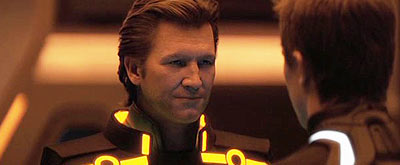
Tony Stark deals with his father’s legacy in Iron Man 2. Robert Fischer’s feelings toward his recently departed father make possible the titular mind-crime in Inception. In The Town, Ben Affleck’s character has a troubled relationship with his jailed dad. Even the critically panned Wall Street 2: Money Never Sleeps is about the daughter of Gordon Gekko. (Okay, it was actually about her boyfriend, but still.) It’s easy to wonder if it’s just coincidence—after all, fraught relationships are an easy way to raise the emotional stakes in a story—or if there’s something going on the in popular subconscious. No recent movie has put father-son dynamics as close to the forefront, though, as Tron: Legacy.
(more…)
Comments Off on The Dad Abides: Tron: Legacy
The Big, Bad World Of The Good Wife
Published on January 30th, 2011 in: All You Need Is Now, Current Faves, Feminism, Issues, TV |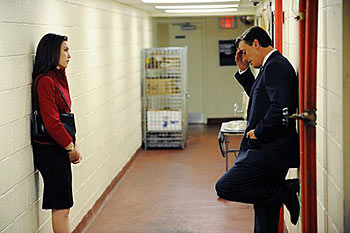
Alicia and Peter Florrick
At first, preview spots for CBS’s The Good Wife looked less than promising: another press conference, about another cuckolded wife of a politician. Even the casting of dashing Chris Noth and long-absent-from-TV Juliana Marguiles didn’t appeal to me.
Then there was the name of the show itself: The Good Wife. It just seemed . . . stuffy.
I started catching bits and pieces of the show by accident. Despite my misgivings, it was actually intriguing, on par with the best episodes of Law & Order (Rest In Peace). Then one night I was flipping channels and there was Alan Cumming as conniving political campaign manager Eli Gold, bitching out and out-bitching some snarky-looking teenage girl. Suddenly, I was hooked.
Comments Off on The Big, Bad World Of The Good Wife
Sometimes Undead Is Better: The Walking Dead
Published on January 30th, 2011 in: All You Need Is Now, Current Faves, Horror, Issues, TV |By Less Lee Moore
Although I’ve never read The Walking Dead comic series, I have been intrigued ever since Popshifter covered it in a past Halloween issue. When news of the AMC series popped up, I was relieved that it was receiving the episodic TV treatment; it seemed far too complex for a 90-minute movie. Interesting then, that the premiere episode was about that long, and far more engaging than much of the new breed of undead that has infected pop culture.
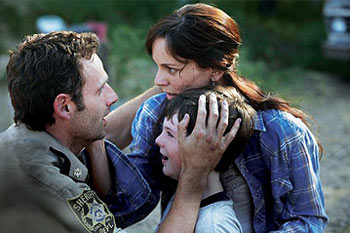
Rick, Lori, and Carl
As a diehard horror fan, my affections are frequently misunderstood or misinterpreted as some kind of prurient interest in the sick and depraved. Like all good additions to the horror canon, however, The Walking Dead isn’t just about zombies, the undead, or as the show itself refers to them, “Walkers.” Its social commentary is less heavy-handed than the recent spate of Romero zombie creations, but far more relevant. In fact, The Walking Dead has succeeded where four (or five) seasons of LOST failed: deftly mixing interpersonal drama with a touch of the supernatural, to raise provocative questions about our society.
(more…)
Sherlock Holmes Has A Cell Phone
Published on January 30th, 2011 in: All You Need Is Now, Current Faves, Issues, TV |By Lisa Anderson
In Central London, Scotland Yard is holding a press conference about a recent spate of suicides. The Detective Inspector insists that the deceased must all have something in common, and instantly, everyone present—police and press alike—receives a text stating simply: “Wrong!” Later that week, an army doctor, just back from Afghanistan, is checking out a potential flat with the strange, misanthropic young man he met only the day before. The landlady asks how many bedrooms they’ll be needing, saying that it’s okay if it’s only one. “Of course we’ll be needing two!” the doctor protests, shocked.
Both of these scenes take place in Sherlock, a miniseries created by the BBC but which also aired on PBS’s Masterpiece Mystery. They also both illustrate the way this contemporary retelling brings Sir Arthur Conan Doyle’s detective into the modern world, with its ever-changing technology and complicated social realities.
(more…)
The Cape: Learnin’ The Tropes
Published on January 30th, 2011 in: All You Need Is Now, Current Faves, Issues, TV |By Cait Brennan
Television has changed mightily since 2004, when a little show called Lost took to the airwaves and left behind a trail of time-traveling, Old Testament, daddy-issue, polar bear carnage. One after another, the networks have pelted home viewers with high-concept sci-fi and fantasy adventures, ranging from engaging (the unjustly canceled Invasion) to laughable (really? a reboot of V?) to just plain stultifying (The Event).
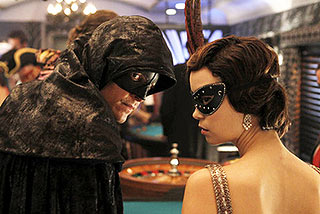
The Cape and Orwell
None of these genre efforts better typified pop culture’s creepy-uncle embrace of comic book culture than Heroes. Engaging and original in its first season, Heroes took a great cast of characters and ran them around in angel-dust spaghetti-squash circles for its last three years, finally collapsing under the weight of a mythos so impenetrable it made The X-Files look like Three’s Company. Strange and even brave, then, that NBC greenlit another big budget superhero show so soon after Heroes‘ implosion. It’s a good thing they did, because The Cape is a lot of fun—a show that both embraces and spoofs comic book tropes, with a rogue’s gallery of great characters that make it all worthwhile.
(more…)
Comments Off on The Cape: Learnin’ The Tropes