Nothing Can Stop Us: Anti-Thatcherism and Anti-Conservatism in Music, 1980 – 1987
Published on May 30th, 2009 in: Issues, Music, Retrovirus |By Emily Carney
With all the will in the world
Diving for dear life
When we could be diving for pearls
—Elvis Costello, “Shipbuilding” (performed by Robert Wyatt)
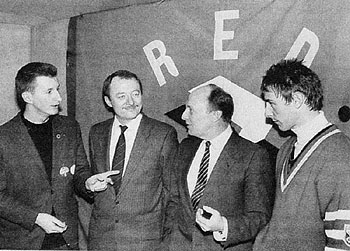
Red Wedge meeting
(L – R, Billy Bragg, Ken Livingstone,
Neil Kinnock, Paul Weller)
Photo from Weller World
It almost goes without saying that many in ’80s England were dissatisfied with the rule of Prime Minister Margaret Thatcher. She was depicted as the “Iron Lady” and was the poster girl for the Conservative Party, one who became increasingly bent on waging war (the Falklands War, to be specific). Other political issues plagued the UK at the time, such as high unemployment rates, and despite the often-jocular mood of the film 24 Hour Party People, England is also portrayed as being throttled by unbelievable crises, such as gravediggers striking and garbage piling up in cities. These events symbolized the feeling of many that things had gotten well out of control.
The Falklands conflict, along with increasingly conservative sentiment across both sides of the Atlantic Ocean, signaled the beginning of Socialist-flavored protest music in England. Producer Clive Langer and Elvis Costello penned a song called “Shipbuilding,” which detailed the desperation of a man who had little money and whose son died in a bid to work at a shipyard full of warships because “it’s all we’re skilled in.” This song was recorded by the English vocalist Robert Wyatt in 1982, formerly of the progressive rock band Soft Machine; the crushing sadness of his voice underscored the feelings of alternate apathy and disgust in a government which seemed unconcerned with sending people to their graves to make a statement. (Costello released his own version in 1983.)
Wyatt’s 1982 album, Nothing Can Stop Us, also contains a tune called “Stalin Wasn’t Stallin'”, an American gospel song meant to extol the virtues of Stalin’s resistance towards the Nazis in World War II. Yet his version of “Shipbuilding” remains the gold standard of this spellbinding song. Wyatt, in covering it, meant to remind the United States and the UK that the Soviet Union had once attempted to forge an alliance. Wyatt also covered “At Last I Am Free,” a song by the dance band Chic, which served as a poignant reminder of good times past, but yet rang out like a political proclamation invoking “freedom”; the song is rendered utterly eerie with Wyatt’s multi-tracked, distinctive vocals and keyboards.
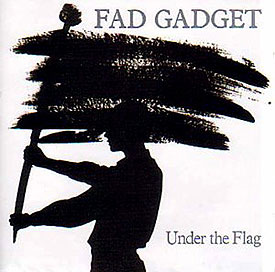
Also in 1982, Fad Gadget’s album Under the Flag was released, which contained songs such as “The Sheep Look Up,” and of course the album’s title tracks (“Under the Flag I” and “Under the Flag II”). Frank Tovey (who masterminded the alter ego of Fad Gadget) admitted his album had been written in a two-week period following the inception of the Falklands War. His songs are very close in mood to “Shipbuilding,” and are closer to folk music than the avant-garde synth pop he had previously been associated with.
Another act associated with gleeful synth pop around this time was Heaven 17; the group consisted of two ex-members of the Human League and a new vocalist, Glenn Gregory. In early 1981, Heaven 17 released a song called “We Don’t Need This Fascist Groove Thang,” marrying funky dance beats (which remain remarkably undated) to commentary about the popularity of conservatism in the US and the UK in the early 1980s. The song’s “good times” bounce almost distracts the listener from the lyrics, which warn of a “Fascist thang advancing” across the Atlantic (at the time, Reagan was President-elect) and entices people to “grab that groove thang by the throat/and throw it in the ocean.”
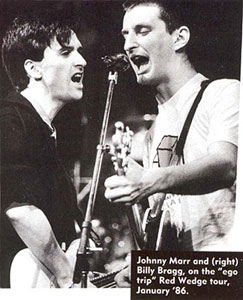
Johnny Marr and Billy Bragg
Photo from Mojo Magazine
Heaven 17 were from Sheffield, a city which was widely associated with Leftist political views. Their politics influenced their first and second albums (Penthouse and Pavement and The Luxury Gap); this was most obvious in the songs titled “Let’s All Make a Bomb” and “Crushed by the Wheels of Industry.” Heaven 17 also poked holes in the image of early 1980s “yuppies” by presenting themselves as yuppie “movers and shakers” on the cover of the album Penthouse and Pavement. The band members are seen variously making businesslike handshakes brokering “deals” and answering phones, images associated with early 1980s stockbroker excess. (Apparently the album cover was influenced by a corporate flyer, which contained similar images.) Heaven 17’s output became increasingly less Leftist during the 1980s, but their earlier songs capture a feeling of sarcastic, subtle rebellion.
The most vocal group opposed to Prime Minister Thatcher’s policies during the 1980s remains the musical collective known as Red Wedge. Red Wedge (named after a poster by Russian lithographer El Lissitzky) was not a Communist group and was not officially aligned with the Labour Party; however, the group did organize tours with artists firmly allied to the Left such as Billy Bragg, The Style Council, and The Smiths. Red Wedge’s aim was to motivate English youths to vote for Labour Party candidates in the 1987, effectively ending the influence of Margaret Thatcher’s policies.
Members of Red Wedge were also active in the media in order to further educate youth about politics. The group was ultimately unsuccessful in their goal to oust Conservatives from office in 1987, but the music generated by artists associated with the movement gave youths who were disgusted with the state of the nation their very own forum. Red Wedge ultimately disbanded after the 1987 election.
While the protest movements associated with anti-conservatism died out in the late 1980s, the music still remains, relatively undated. Perhaps Billy Bragg’s song “A New England” best emphasizes the feelings of the time (notwithstanding Wyatt’s “Shipbuilding”), containing a mix of barely controlled desperation tinged with resigned apathy:
I don’t want to change the world
I’m not looking for a new England
I’m just looking for another girl
I don’t want to change the world
I’m not looking for a new England
3 Responses to “Nothing Can Stop Us: Anti-Thatcherism and Anti-Conservatism in Music, 1980 – 1987”
July 30th, 2009 at 2:21 pm
Chuffed to see a Robert Wyatt reference on Popshifter!!
November 29th, 2009 at 9:04 pm
[…] Nothing Can Stop Us: Anti-Thatcherism And Anti-Conservatism In Music, 1980 – 1987, Popshifter May/June 2009 issue […]
March 18th, 2010 at 8:32 pm
[…] 2010 … As reconstructed by Neil C. Livingstone and David Halevy in Washingtonian magazine, he …Popshifter Nothing Can Stop Us: Anti-Thatcherism and Anti …(L R, Billy Bragg, Ken Livingstone, Neil Kinnock, Paul Weller) Photo from Weller World. It almost […]
Time limit is exhausted. Please reload the CAPTCHA.