Married and Buried: Punk As A Four-Letter Word, Part Two
Published on March 30th, 2008 in: Books, Issues, Music, Retrovirus, We Miss The Nineties |By Less Lee Moore
Read Part One of this article here.
This year, I got a copy of Nirvana, a book by music journalist Everett True. Although I own Come As You Are by Michael Azerrad, I’ve never even read it. So to be fair, I read Azerrad’s book first.
Not long into it, I started to feel uncomfortable. Granted, the book came out six months before Cobain’s death, but there were a lot of holes in the story, for example: What was the explanation for the unlikely armistice Azerrad describes between Courtney and the rest of Nirvana? Why was there no mention of what happened to Courtney’s relationship with Billy Corgan?
Azerrad’s book provides too many junior-high-school essays on Cobain’s lyrics and not enough credible facts. How has this book become so adored by Nirvana fans and music critics, even snagging top spots on Best Rock Biography lists?
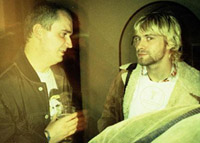
Everett True with Kurt Cobain.
Photo © Everett True
Unlike Azerrad, Everett True doesn’t sound like a hack writer who employs the tactics of William Randolph Hearst. He seems like a music fan, someone who genuinely loves Nirvana, not because they were popular or the voice of a generation, but because they meant something to him personally.
At 600+ pages, the book may seem bloated, but True delves into the history of the various music scenes and movements that spawned Nirvana, something which Azerrad only perfunctorily attempts.
True reminded me what I liked about Nirvana in the first place, although I didn’t like them until they were gone: they were punk. Not the Hot Topic, Green Day pastiche that tweens adore while those in middle age groan, but the anti-corporate, DIY, screw-the-establishment stance that seems completely absent in a post-American Idol world. Although the word “punk” has become a marketing tool it’s not exactly a recent transformation.
Although I like the Sex Pistols just fine, it’s difficult to reconcile Vivienne Westwood’s Sex clothing boutique and Malcolm McClaren’s svengali tactics with the spirit of rebellion. What could be more establishment-friendly than taking street fashion and turning it into haute couture?
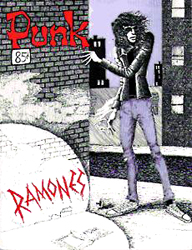
Though I’ve only read excerpts, I adore Punk Magazine, started by Legs McNeil and John Holmstrom in the 70s. McNeil says he wanted people to think they were cool and hang out with them, claiming that “the magazine was started strictly so that its creators could ‘hang out with the Dictators.’ ” They chose the name “Punk” because “it seemed to sum up. . . everything. . . obnoxious, smart but not pretentious, absurd, ironic, and things that appealed to the darker side.” (1)
This is why I love Redd Kross. Obnoxious, smart but not pretentious, absurd, ironic, and appealing to the darker side? Yes to all of the above. They embraced punk when they discovered Lydia Lunch as young kids, picked up guitars, and recorded a cover of a Charles Manson song. They didn’t try to fit into the rigid aesthetic of the hardcore scene; they liked The Partridge Family! And they liked them even though they weren’t considered punk rock. Redd Kross still retains a sensibility encompassing the rebellion of punk and the light-heartedness of bubblegum.
This is also what made Nirvana significant. Although the fashion industry was quick to capitalize on the “grunge” trend, with Vogue photo spreads (sound familiar?), the atmosphere that birthed Nirvana and their contemporaries was the same anti-corporate, DIY, screw-the-establishment stance found in the punks of the 70s and the hardcore bands of the 80s. Like Redd Kross, Kurt Cobain was full of contradictions; he adored the Butthole Surfers while simultaneously covering The Vaselines.
Grunge may have begun as a six-letter word for punk but by 1993, it became a dirty word, thanks to watered-down crap like Singles and bandwagon-hopping like Stone Temple Pilots (who later ripped off Redd Kross with “Big Bang Baby”). There is nothing grunge or punk about Cameron Crowe or Scott Weiland.
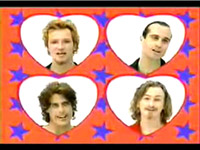
Stone Temple Poseurs
This is why the Chart editorial bothers me. Although Brophy accurately notes that the mainstream media’s exploiting of grunge was the harbinger of the disturbing trend of co-opting underground/alternative music, he dismisses Nevermind as “not that hot,” which ironically glosses over the fact that perhaps no one was more distressed by Nevermind‘s popularity than Kurt Cobain himself. Remember, it was the sexist, volleyball-playing frat guys who kept me away from Nirvana, even though Nirvana stood against everything those guys represented.
Something more insidious bothers me, however, after reading Everett True’s book. Although True was a Hole fan and later a friend of Courtney Love, this friendship ended in animosity. While I know that history is often twisted by the personal feelings and views of the author, not to mention the rampant drug use among Cobain, Love, their friends, and associates, the continual descriptions of Love’s manipulative self-aggrandizement haunt me.
One of Love’s teenage diary entries regarding her plans for becoming famous is quoted and includes, “Number five: Befriend Michael Stipe,” a goal unsettling in both calculation and prescience. (2) But this is the least upsetting revelation.
I already knew about a drunk Eddie Van Halen calling Pat Smear a “n**ger” backstage at a Nirvana show. But True claims that while this took place, Courtney was “complaining” to Nirvana manager John Silva that Kurt was “treating Eddie Van Halen meanly.” (3) It’s another in a long list of incidents True describes where Love seemed more concerned with Kurt’s image than his integrity—or health.
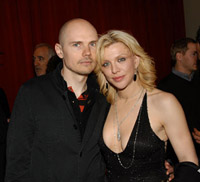
Billy Corgan and Courtney Love, 2006
Photo © PerezHilton.com
True also elucidates the aftermath of Love and Billy Corgan’s break-up (4) and quotes those who say Cobain suspected she was cheating on him with Corgan. (5) Cobain and Love’s former lawyer states that Kurt called her shortly before his death to inquire about divorce proceedings. (6)
True’s book is not a character assassination, however; he quotes many people who commend Courtney’s talent, intelligence, wit, and passion for life, including those who later came to avoid or even despise her. Her staunchest defender is L7’s Jennifer Finch, whom she was friends with since their teen years. Yet the overall portrait of Love that is painted seems to fill in all the blanks that have nagged me for years, making me wonder if I should have ever defended her.
I never understood why the remaining members of Nirvana hated Love so much. I knew it couldn’t be something as ridiculous those spurious claims that she introduced Cobain to heroin or got pregnant on purpose to ensnare him (claims which True and his sources vehemently decry).
True provides continual, detailed descriptions of Love’s schemes to control Kurt’s career and isolate him from his bandmates and friends while simultaneously courting his management and record label. Krist Novoselic and Dave Grohl’s animosity towards her sounds less like sour grapes and more like corroborating evidence. This becomes more convincing because True seems like such a forthright, knowledgeable person. Before I read his characterization of Come As You Are as “a futile attempt to stop. . . scurrilous reportage on [Nirvana]” (7) and Azerrad as “chosen by Kurt’s management” to be “a safe pair of hands,” (8) I’d already made those leaps in my mind.
By the time I got to the end of the book, I felt profoundly miserable. I know all too well that charisma, intelligence, and physical beauty are a powerful combination, sometimes powerful enough to mask a dark and twisted heart, and not the good, punk rock kind. If I could be fooled in one brief encounter with Courtney Love, how on earth could someone in love with her have resisted? No, she didn’t kill him or even drive him to commit suicide, but she sure seemed to have made his life miserable towards the end.
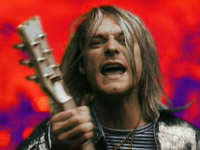
Kurt Cobain in a still from
Nirvana’s “Heart Shaped Box” video
It seems that Love’s manipulations were yet another burden on Cobain’s frail shoulders, already faltering under the weight of intense fame, drug addiction, and the inner turmoil that playing the corporate game created. Will Nirvana’s legacy be forever tainted by the shadow of her self-aggrandizement? Sure she made “You Know You’re Right” available, but she also made Cobain’s personal diaries available. And for what? More plastic surgery? Legal fees? Rehab? She has frequently condemned Novoselic and Grohl for taking food out of Frances’ mouth, but anyone who knows the fortune Cobain amassed in the years before his death can see that charge is ridiculous.
I know that the Sex Pistols had something valid to say and were not puppets operated by Malcolm McLaren, but his role in their story casts a pall over their accomplishments, and perhaps this is the same thing that bothers Aaron Brophy about grunge. It saddens me to see punk idealism corrupted by the establishment it fought against in the first place, just as it saddens me to see the media’s version of grunge eclipse what it stood for.
It may be misguided, but I can’t help but see this tale as Another Great Rock ‘n’ Roll Swindle, starring Kurt Cobain and Nirvana as the last hope for subverting the mainstream from within, and Courtney Love as the femme fatale, representing the establishment who crushed that hope under her designer heels.
Sources:
1. Wikipedia, “Legs McNeil”
2. Everett True, Nirvana (Da Capo Press, 2007), 267
3. Ibid., 530
4. Ibid., 307-8
5. Ibid., 540-1
6. Ibid., 543
7. Ibid., 484
8. Ibid., 569
One Response to “Married and Buried: Punk As A Four-Letter Word, Part Two”
July 22nd, 2014 at 4:18 pm
Heavier Than Heaven by Charles. ‘R’. Cross is The Nirvana book to have. Everett ‘Jerry Thackray’ True is as you’ve described him,so, yes – his book will be worth a read.
Time limit is exhausted. Please reload the CAPTCHA.